
Fumaria vaillantii
Fumaria vaillantii
Fumaria vaillantii, commonly known as Vaillant's fumitory, belongs to the Papaveraceae family. It is an annual herbaceous plant often found in arable land and field margins.
What the section contains
Fumaria vaillantii
The plant originates from the Mediterranean region and has spread across Europe, Central Asia, and parts of the Caucasus. It thrives in open, sunny habitats with moderate temperatures.
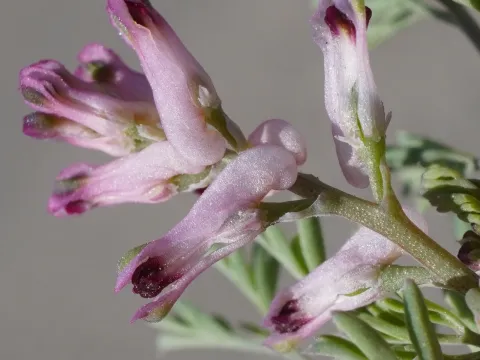
Morphologically, the plant is characterized by a sprawling or ascending stem and finely divided, feathery leaves. Its flowers are small, pale pink to lilac, and arranged in dense racemes.
Vaillant's fumitory requires well-drained, fertile soil to develop fully. It is particularly responsive to nitrogen-rich environments, which is why it often appears in well-fertilized crop fields.
It acts as a competitive species in agricultural ecosystems. Its growth cycle is synchronized with spring crops, allowing it to rapidly utilize available sunlight and soil resources.
Like many members of the Papaveraceae family, Fumaria vaillantii can be affected by powdery mildew. This fungal disease spreads rapidly in humid and warm weather conditions.
Pests such as aphids and specialized leaf beetles are common inhabitants of the plant. While they may cause minor damage, they generally do not control the population of the weed effectively.
In agricultural settings, the main threat is competition with crops for nutrients and water, which results in reduced biomass and yield for the main agricultural production.
Chemical control is usually achieved through the application of selective herbicides during the early vegetative stage. Proper timing is critical to prevent the plant from setting seeds.
Cultural control practices involve deep plowing and crop rotation, which help to bury seeds and disrupt the life cycle of the plant, preventing its proliferation in the next season.