
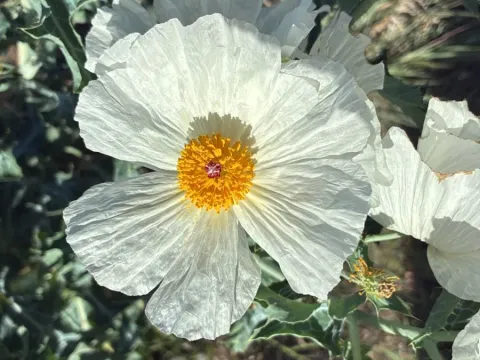
Argemone polyanthemos
Argemone polyanthemos
Argemone polyanthemos, commonly known as the crested prickly poppy, is a resilient herbaceous plant belonging to the Papaveraceae family.
What the section contains
Argemone polyanthemos
Sowing should be performed in early spring as soon as the soil has sufficiently warmed, allowing for consistent germination across the field.
Seeds are sown shallowly in well-prepared, loose soil, ensuring that the taproot can penetrate deeply without early obstruction.
Proper spacing of 30 to 50 centimeters between plants is essential to prevent overcrowding and to promote healthy individual plant development.
As the plant is sensitive to root disturbance, direct seeding into its final growing location is highly recommended for commercial production.
This species thrives in full sun and requires well-drained, sandy, or rocky soil conditions to prevent the accumulation of excess moisture.
It is exceptionally drought-tolerant and well-adapted to arid environments, making it suitable for low-input agricultural systems.
Soil pH levels should generally be neutral to slightly alkaline for optimal nutrient uptake and growth performance in the field.
Over-fertilization is counterproductive, as it weakens the plant structure and increases susceptibility to opportunistic pathogens.
The plant requires minimal maintenance, provided that the initial site selection ensures adequate sunlight exposure and good drainage.
- Seed yield depends heavily on local precipitation and soil quality during the flowering period.
- The oil content in seeds is a significant area of research for potential industrial applications.
- Biomass production can be substantial in native habitats with favorable late-summer rainfall.
- Consistent environmental conditions contribute to uniform seed maturation and easier harvest logistics.
- Yield stability is maintained through the plant's inherent resistance to common heat stress factors.
Root rot represents the most critical threat to the crop, typically triggered by high soil moisture and inadequate drainage systems.
Powdery mildew may occur in stagnant air conditions, necessitating careful spacing and weeding to ensure optimal ventilation.
Insects like aphids or spider mites can occasionally affect young plants but are rarely problematic in well-managed, open-field systems.
The plant produces secondary metabolites, including isoquinoline alkaloids, which act as a natural deterrent against various herbivores.
Effective management of invasive tendencies is required, as the plant can readily self-seed and spread to adjacent agricultural areas.
Harvesting should occur when the capsules have turned brown and become brittle, signaling that the seeds have reached full maturity.
Timely harvesting is crucial, as the capsules are prone to natural dehiscence, which can lead to significant yield loss through scattering.
The entire plant or just the capsule-bearing tops can be collected and placed on drying racks to finalize the maturation process.
Threshing is performed once the capsules are fully dry, separating the seeds from the chaff using conventional winnowing methods.
Stored seeds must be kept in a cool, dry environment to prevent mold growth and to maintain high viability for future planting seasons.