
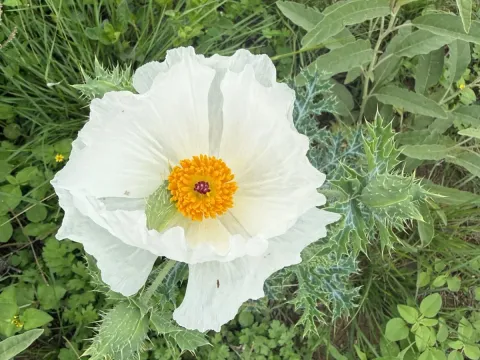
Orange prickly poppy
Argemone aurantiaca
The propagation of the orange prickly poppy is performed via seeds. Planting should occur in early spring once the soil has warmed up, ensuring optimal conditions for germination and early establishment.
What the section contains
Orange prickly poppy
Seeds require light exposure and should be sown at a shallow depth, usually no more than half a centimeter. Firming the soil lightly after sowing improves seed-to-soil contact and moisture absorption.
Row spacing should be maintained at 40 centimeters to allow for adequate airflow between mature plants. This prevents the development of diseases caused by high humidity or trapped air.
As a robust species, it does not require complex pre-planting seed treatments, although scarification might improve germination rates for long-stored seeds.
After thinning the seedlings, it is important to keep the field weed-free, especially in the first month, to ensure the crop establishes a dominant position in the area.
This member of the Papaveraceae family thrives in arid and semi-arid environments. It is characterized by its high tolerance to heat and drought, making it suitable for regions with limited rainfall.
Full sun exposure is a mandatory requirement for healthy development. The plant relies on intense solar radiation to support its physiological processes and growth cycles.
It prefers well-drained, porous soils. Sandy or sandy-loam soils are ideal, as they prevent water accumulation around the roots, which is the primary cause of failure in cultivation.
The plant is highly resilient and can tolerate low-nutrient soils, demonstrating an efficient use of available minerals even in challenging geological conditions.
While tolerant to dry conditions, supplemental irrigation during the initial germination phase can significantly increase the final density of the stand.
The primary threat to orange prickly poppy crops is root rot, which typically arises from waterlogged conditions. Once established in the root system, it is difficult to eradicate.
Foliar pests like aphids and mites are common. They colonize the underside of leaves and stems, stressing the plant and potentially vectoring viral diseases.
Powdery mildew is a frequent occurrence in climates with fluctuating humidity levels. It creates a dusty appearance on the foliage and restricts photosynthetic capacity.
Effective pest management involves integrated methods, focusing on maintaining dry conditions and keeping the plant population density at an appropriate level.
- Maintaining dry conditions for the root zone.
- Using systemic insecticides only if infestations are severe.
- Removing infected debris to reduce pathogen overwintering.