
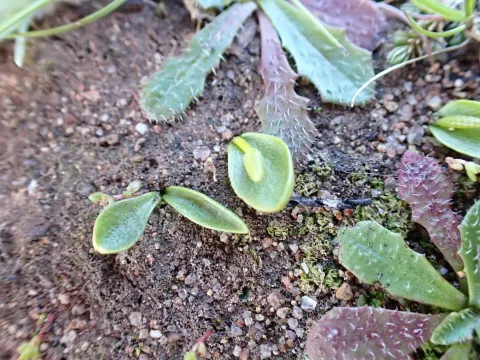
Adder's-tongue
Ophioglossum
Adder's-tongue (Ophioglossum vulgatum) is a perennial spore-bearing plant belonging to the Ophioglossaceae family. While not a commercial crop, it is a plant of significant interest in ecological studies and rare plant conservation.
What the section contains
 Adder's-tongue fern
Ophioglossum coriaceum
Adder's-tongue fern
Ophioglossum coriaceum
 Adder's-tongue fern
Ophioglossum pedunculosum
Adder's-tongue fern
Ophioglossum pedunculosum
 Adder's-tongue fern
Ophioglossum vulgatum
Adder's-tongue fern
Ophioglossum vulgatum
 Azorean adderstongue
Ophioglossum azoricum
Azorean adderstongue
Ophioglossum azoricum
 Gomez's adderstongue
Ophioglossum gomezianum
Gomez's adderstongue
Ophioglossum gomezianum
 Lance-leaved adder's tongue
Ophioglossum lancifolium
Lance-leaved adder's tongue
Ophioglossum lancifolium
 Net-veined adder's-tongue
Ophioglossum reticulatum
Net-veined adder's-tongue
Ophioglossum reticulatum
 Ophioglossum costatum
Ophioglossum costatum
Ophioglossum costatum
 Ophioglossum pendulum
Ophioglossum pendulum
Ophioglossum pendulum
 Ophioglossum polyphyllum
Ophioglossum polyphyllum
Ophioglossum polyphyllum
 Ophioglossum thermale
Ophioglossum thermale
Ophioglossum thermale
 Portuguese adder's-tongue
Ophioglossum lusitanicum
Portuguese adder's-tongue
Ophioglossum lusitanicum
Adder's-tongue
The plant thrives in moist meadows, damp woodland clearings, and riparian areas. It requires a stable moisture level in the soil to support its unique physiological processes throughout the growing season.
Ideal soil conditions include a neutral to slightly acidic pH, rich in organic matter. Proper soil structure is necessary to ensure adequate aeration while preventing the waterlogging of the roots.
The species prefers temperate climatic zones where it can benefit from distinct seasonal changes. Its deep-seated rhizome allows it to survive harsh winters, ensuring perennial growth for many years.
Botanically, Ophioglossum is distinguished by a single sterile frond and a solitary fertile spike, which sets it apart from more common fern species found in similar ecosystems.
The primary threat to Adder's-tongue populations is land-use change, specifically the conversion of natural meadows into cultivated fields or heavy livestock grazing that destroys topsoil.
Large-scale drainage projects aimed at reclaiming wetlands lead to the immediate destruction of suitable habitats, preventing the germination of spores and the establishment of new plants.
The plant is susceptible to fungal infections during prolonged periods of excessive humidity, which can affect the health of the rhizome and the viability of the fertile spike.
Soil-dwelling pests and insects can inflict damage on the underground structures of the plant, especially during the early phases of spring regrowth.
Intense competition from aggressive grasses and invasive weeds can easily overwhelm Ophioglossum, as it is a slow-growing plant that lacks the ability to quickly colonize new areas.