
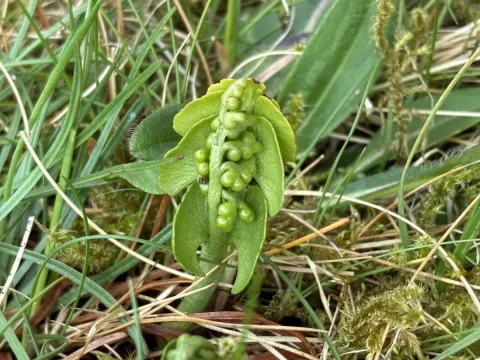
Moonwort
Botrychium
Moonwort (Botrychium) is a genus of small perennial ferns belonging to the Ophioglossaceae family. It is not considered a cultivated crop; rather, it is a botanical specimen often found in wild, undisturbed natural habitats across the Northern Hemisphere.
What the section contains
 Japanese moonwort
Botrychium japonicum
Japanese moonwort
Botrychium japonicum
 Lance-leaf grapefern
Botrychium lanceolatum
Lance-leaf grapefern
Botrychium lanceolatum
 Leathery grape fern
Botrychium multifidum
Leathery grape fern
Botrychium multifidum
 Little grapefern
Botrychium simplex
Little grapefern
Botrychium simplex
 Matricary grapefern
Botrychium matricariifolium
Matricary grapefern
Botrychium matricariifolium
 Moonwort
Botrychium lunaria
Moonwort
Botrychium lunaria
 Northern Moonwort
Botrychium boreale
Rattlesnake fern
Botrychium virginianum
Northern Moonwort
Botrychium boreale
Rattlesnake fern
Botrychium virginianum
Moonwort
The plant thrives in specific ecological niches, including moist grasslands, shaded clearings, and woodland edges. It requires a stable soil environment rich in symbiotic fungi, which are essential for its slow and complex life cycle.
Climatic requirements are strictly related to temperate regions. The plant is highly sensitive to temperature fluctuations and soil compaction, making it nearly impossible to introduce into conventional agricultural settings.
Botanical features include a distinct vegetative leaf and a fertile segment that produces spores. Because the plant relies on underground mycorrhizal associations, it remains extremely rare and difficult to propagate outside its natural territory.
There is no economic or agricultural use for Moonwort. It is generally protected by conservation laws in many regions, and its presence serves as an indicator of an ecosystem's high biodiversity and environmental health.
The primary threats to Botrychium populations include habitat loss due to land development, the loss of symbiotic fungi due to soil chemistry changes, and excessive grazing that physically destroys the delicate fronds.
Regarding pests and diseases, the plant does not face typical agricultural issues. However, it is highly susceptible to displacement by invasive species and weeds that thrive in nutrient-rich soils, which eventually shade out the slower-growing Moonwort.