
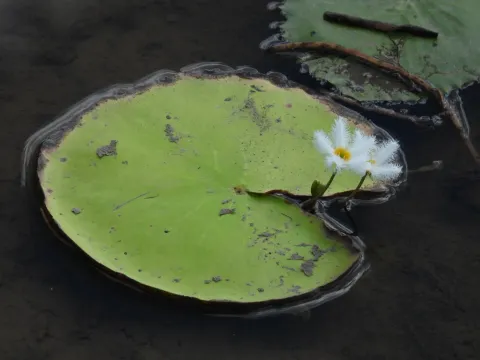
Water snowflake
Nymphoides indica
Nymphoides indica, commonly known as Water snowflake, is a perennial aquatic plant belonging to the Menyanthaceae family. It is native to tropical regions of Africa, Asia, and Australia, flourishing in ponds, lakes, and slow-moving streams.
What the section contains
Water snowflake
The plant requires water temperatures between 20°C and 28°C to thrive. It is sensitive to sudden thermal changes, which can lead to leaf yellowing or stunted growth if the temperature falls consistently outside this range.
Bright, filtered light is essential for the healthy development of Nymphoides indica. It performs best under intense lighting for 10–12 hours daily. If the light intensity is too low, the plant will produce excessively long petioles, losing its compact structure.
The substrate should be rich in organic matter to support the rapid growth of the rhizome system. A mixture of fine gravel, peat, and nutrient-rich soil tablets placed around the base is recommended to ensure adequate feeding.
Good water circulation is vital for plant health, as it ensures an even distribution of nutrients and CO2. Regular monitoring of nitrate and phosphate levels is necessary to prevent nutrient imbalances that could impact the plant's vitality.
The most common threat to the Water snowflake is the proliferation of filamentous algae. These can easily choke the leaves, limiting their ability to photosynthesize and absorbing the nutrients intended for the plant.
Snails and other herbivorous aquatic invertebrates are known to feed on the tender floating leaves. Protecting the plant from these pests is important, especially in the early stages of its establishment in a new environment.
Disease outbreaks often occur as a result of poor water quality. High ammonia or nitrate levels can lead to the melting of leaves and the rotting of the rhizomes, requiring immediate water changes to stabilize the system.
Deficiencies in essential micronutrients like iron can cause chlorosis. If the leaves start to pale and lose their vibrant green, a targeted approach with iron-supplemented liquid fertilizer is usually required to restore health.
Fungal infections can set in if the plant is mechanically damaged during maintenance. It is important to handle the leaves and stems with care to prevent creating entry points for opportunistic pathogens that can rot the plant tissues.