
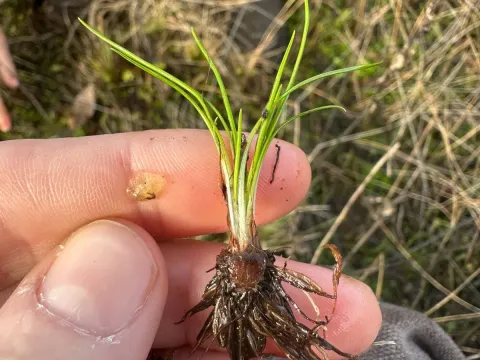
Quillwort
Isoetes
Quillwort (genus Isoetes) constitutes a group of perennial lycophytes belonging to the family Isoetaceae. These plants are considered living fossils, serving as the only surviving descendants of an ancient order Isoetales, which included massive, tree-like species that dominated forests during the Paleozoic era.
What the section contains
 Bory's quillwort
Isoetes boryana
Bristly quillwort
Isoetes setacea
Chinese quillwort
Isoetes sinensis
Coromandel quillwort
Isoetes coromandelianum
Bory's quillwort
Isoetes boryana
Bristly quillwort
Isoetes setacea
Chinese quillwort
Isoetes sinensis
Coromandel quillwort
Isoetes coromandelianum
 Drummond's quillwort
Isoetes drummondii
Indian quillwort
Isoetes indica
Drummond's quillwort
Isoetes drummondii
Indian quillwort
Isoetes indica
 Isoetes azorica
Isoetes azorica
Isoetes azorica
 Isoetes brochonii
Isoetes brochonii
Isoetes brochonii
 Isoetes durieui
Isoetes durieui
Isoetes durieui
 Isoetes subinermis
Isoetes todaroana
Isoetes todaroana
Isoetes subinermis
Isoetes subinermis
Isoetes todaroana
Isoetes todaroana
 Isoetes velata
Isoetes velata
Isoetes velata
 Italian quillwort
Isoetes malinverniana
Italian quillwort
Isoetes malinverniana
 Japanese quillwort
Isoetes japonica
Lake Bracciano quillwort
Isoetes sabatina
Long-leaved quillwort
Isoetes longissima
Olympus quillwort
Isoetes olympica
Quillwort
Isoetes lacustris
Japanese quillwort
Isoetes japonica
Lake Bracciano quillwort
Isoetes sabatina
Long-leaved quillwort
Isoetes longissima
Olympus quillwort
Isoetes olympica
Quillwort
Isoetes lacustris
 Sand quillwort
Isoetes histrix
Sand quillwort
Isoetes histrix
 Spiny-spored quillwort
Isoetes echinospora
Spiny-spored quillwort
Isoetes echinospora
Quillwort
The genus is distributed globally, inhabiting diverse environments ranging from clear lakes and ponds to vernal pools and wet marshlands. They typically thrive in submerged or semi-aquatic conditions, often anchoring their corm-like stems into sandy or silty substrates at the bottom of freshwater systems.
The botanical structure of Isoetes is defined by a short, fleshy, corm-like stem that bears a rosette of stiff, quill-like leaves. At the base of these leaves, the plant produces sporangia, which house both megaspores and microspores. This reproductive strategy is highly adapted to the fluctuating water levels found in their natural habitats.
To cultivate or support populations of Quillwort, specific environmental parameters must be met, including low water turbidity and oligotrophic to mesotrophic water conditions. The plants are notoriously sensitive to excessive nitrate and phosphate runoff, which often leads to the proliferation of algae that can shade out the smaller Quillwort colonies.
In modern agricultural and environmental contexts, Quillwort is not treated as a traditional crop but serves as a vital bioindicator for the health of wetland ecosystems. Their presence is a sign of high water quality, and they are sometimes managed in professional aquascaping and conservation projects to help restore or maintain biological equilibrium in aquatic environments.