
Spiny-spored quillwort
Isoetes echinospora
Description
Growing requirements
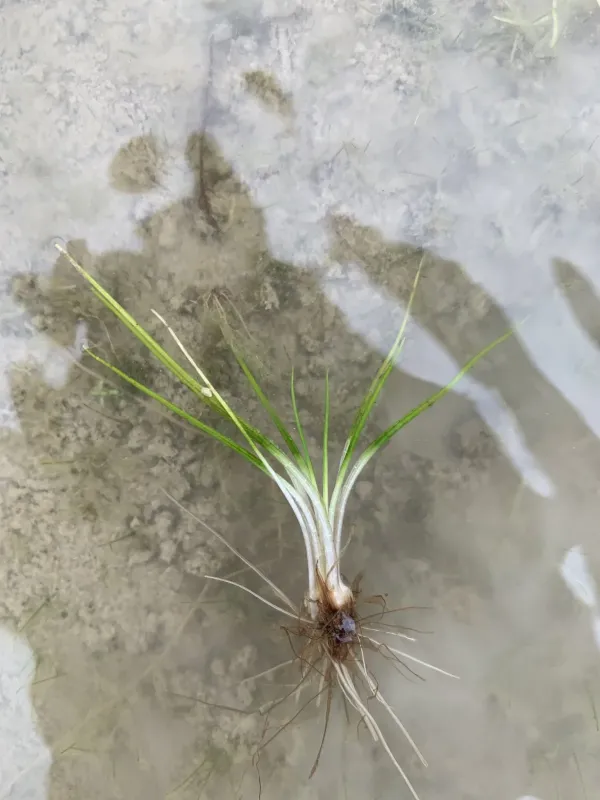
The spiny-spored quillwort (Isoetes echinospora) is a unique perennial lycophyte belonging to the Isoetaceae family. It is an aquatic or semi-aquatic plant that grows as a submerged rosette of thin, grass-like leaves from a central, corm-like base.
Ecologically, this plant is a specialist found in oligotrophic, clear-water lakes and ponds. It requires substrates consisting mainly of sand, gravel, or coarse stones, as it cannot thrive in nutrient-rich or silty bottom conditions.
The global distribution of Isoetes echinospora spans the cooler regions of the Northern Hemisphere, extending into the subarctic zones. It is highly sensitive to the chemical composition of the water, favoring low alkalinity and moderate to cool temperatures.
Botanically, the species is distinguished by its specific megaspore ornamentation, which is covered in long, pointed spines. This feature is diagnostic and serves as the primary method for botanical identification of the plant when spores are present.
The plant demonstrates remarkable physiological adaptation to low-light, low-carbon environments. It utilizes CAM-like photosynthesis, enabling it to survive in deep waters where many other vascular plants would be unable to maintain metabolic balance.
Main diseases and pests
The primary threat to the survival of the spiny-spored quillwort is cultural eutrophication caused by agricultural runoff and wastewater discharge. Increased nitrogen and phosphorus levels stimulate excessive algae growth, leading to competition and light deprivation.
Habitat loss due to water level fluctuations, often caused by dam operations or hydroelectric projects, can dry out established populations or submerge them beyond their tolerance depth. Sedimentation, which blankets the sandy substrate, is equally lethal.
Recreational activities, including the use of high-speed motorized boats and heavy anchor use, cause direct physical destruction to the delicate rosettes. Because the species has a slow growth rate, these disturbances often result in local extirpation.
Climate change poses a significant risk to the plant by increasing water temperatures beyond its physiological threshold. As a cold-adapted species, it struggles to compete with warmer-adapted aquatic vegetation in rising thermal conditions.
As a result of its rarity, Isoetes echinospora is protected in many jurisdictions. It has no agricultural utility and is managed primarily through aquatic conservation efforts aimed at maintaining water clarity and protecting pristine shoreline areas.