
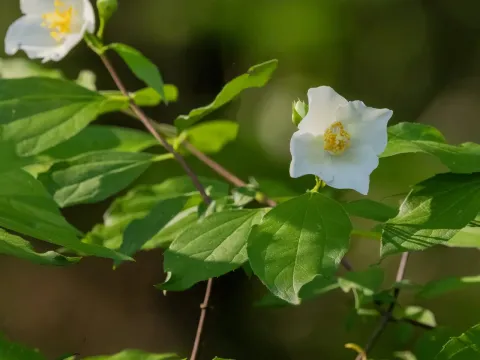
Mock orange
Philadelphus L.
Mock orange (Philadelphus L.) is a genus of deciduous shrubs belonging to the Hydrangeaceae family, widely recognized for its fragrant flowers.
What the section contains
 Delavay mock-orange
Philadelphus delavayi L. Henry
Delavay mock-orange
Philadelphus delavayi L. Henry
 Lewis's mock-orange
Philadelphus lewisii Pursh
Lewis's mock-orange
Philadelphus lewisii Pursh
 Littleleaf mock-orange
Philadelphus microphyllus A. Gray
Littleleaf mock-orange
Philadelphus microphyllus A. Gray
 Mexican mock orange
Philadelphus mexicanus Schltdl.
Mexican mock orange
Philadelphus mexicanus Schltdl.
 Mock orange
Philadelphus coronarius L. x Philadelphus lewisii Pursh
Mock orange hybrid
Philadelphus lewisii Pursh x Philadelphus x virginalis Rehder
Mock orange
Philadelphus coronarius L. x Philadelphus lewisii Pursh
Mock orange hybrid
Philadelphus lewisii Pursh x Philadelphus x virginalis Rehder
 Mock-orange
Philadelphus coronarius L.
Mock-orange
Philadelphus coronarius L.
 Philadelphus delavayi and Philadelphus microphyllus hybrids
Hybrids between Philadelphus delavayi and Philadelphus microphyllus
Philadelphus delavayi and Philadelphus microphyllus hybrids
Hybrids between Philadelphus delavayi and Philadelphus microphyllus
 Virginal Mock Orange
Philadelphus x virginalis Rehder
Virginal Mock Orange
Philadelphus x virginalis Rehder
Mock orange
Originating from temperate regions of North America, Europe, and Asia, these plants have become a staple in ornamental horticulture across the globe.
For optimal growth, the shrubs require full sun to light shade positions and well-draining soil that is rich in organic matter and moisture.
Routine horticultural practices include regular pruning to remove old wood, which promotes vigorous growth and ensures abundant flowering in subsequent seasons.
These plants are highly adaptable to various soil types, provided that the growing medium is not prone to waterlogging, which could cause root rot.
The most common pests affecting Philadelphus are aphids, spider mites, and leaf rollers, which can significantly stunt the growth of young shoots.
Diseases such as powdery mildew and leaf spot may occur, particularly in environments with poor air circulation or excessive leaf humidity during the summer.
Effective pest management involves integrated control methods, including biological sprays or targeted insecticides applied at the first signs of infestation.
Maintaining a clean garden bed around the shrubs helps to reduce the survival rate of dormant pathogens and pests during the winter months.
Regular inspection of the foliage and stems is essential for early detection of issues, allowing for rapid intervention before the health of the plant declines.