
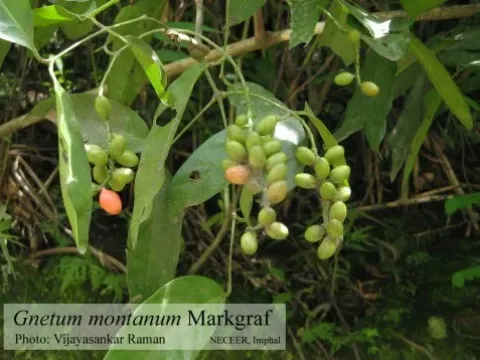
Gnetum montanum
Gnetum montanum
Gnetum montanum is a woody liana belonging to the Gnetaceae family. In its natural habitat, seed propagation typically occurs at the beginning of the rainy season, when soil moisture reaches optimal levels for successful germination.
What the section contains
Gnetum montanum
Under specialized cultivation, seeds are sown into a prepared substrate, maintaining a stable temperature between 22 and 28 degrees Celsius. A key condition for germination is maintaining high air humidity and using a well-drained soil mix to prevent waterlogging.
Nursery propagation is preferred as young plants are extremely sensitive to direct sunlight and temperature fluctuations. Transplanting into the field occurs once the seedling reaches a height of 25-30 centimeters and has developed a sufficiently robust root system.
For vegetative propagation, cuttings from matured shoots are used, which allows for faster acquisition of productive specimens. Cuttings are placed in greenhouses with misting systems to maintain an ideal microclimate.
Rooting takes between two to four months under proper agrotechnical conditions. Once a sufficient number of adventitious roots are formed, the plants are hardened off and planted in their permanent growth location.
Gnetum montanum requires a tropical climate with abundant rainfall for successful growth. The crop prefers areas with good diffused light, as it often grows in the understory of its native environment, using trees for support.
Soils should be fertile with a neutral to slightly acidic pH. A high content of organic matter is a critical factor, so the application of compost or humus significantly boosts the growth intensity of the vines.
The plant does not tolerate prolonged dry periods, so in regions with a distinct dry season, an irrigation system is necessary. Maintaining constant substrate moisture is the key to the plant's vegetative health.
Agrotechnics include the creation of vertical supports, as the plant is a liana. Without proper fixation of the shoots, the plant's development slows down, which negatively impacts biomass yield.
Drainage levels must be controlled, as waterlogged areas lead to fungal infections of the root system and the subsequent death of the vine.
The primary economic products of Gnetum montanum are leaves and seeds, which are widely used in traditional medicine and culinary arts. Yield depends on the age of the plant and the intensity of plantation care.
Seed harvesting is performed upon reaching full maturity when the outer coat develops its characteristic color. Timely harvest is important to prevent fruit drop, as the seeds are a valuable source of nutrients.
Leaf mass is harvested selectively, starting from the second or third year of the plant's life. This practice allows for maintaining the vine's viability and obtaining a stable harvest over many years.
To increase plantation productivity, gentle pruning is applied, which stimulates branching and the formation of more young shoots with tender leaves.
On average, under intensive cultivation, significant amounts of raw material can be obtained per hectare, finding applications in pharmaceutical manufacturing and the local food sector.
Gnetum montanum is susceptible to attacks by sap-sucking pests such as spider mites and various aphid species, especially during periods of low air humidity. Regular inspection of the underside of leaves allows for early detection of infestations.
Root system diseases often arise from poor irrigation management. Fungal infections caused by soil-borne pathogens can spread rapidly in poorly ventilated plantation conditions.
Leaf spot caused by Cercospora fungi is a common issue in regions with high humidity. Prevention involves removing infected leaves and ensuring good air circulation around the plants.
Biological pest control methods, including the use of entomophages or bio-preparations, are recommended. The use of harsh chemical pesticides is not advised, as the produce is often used for human consumption.
Adherence to crop rotation and proper planting spacing helps significantly reduce the risk of large-scale infectious disease outbreaks.
Harvesting of leaves is done manually to ensure the product retains its commercial appearance. The optimal time for harvesting is during the morning hours when plant turgor is at its peak, which facilitates longer shelf life.
After harvesting, the leaves undergo primary sorting to remove damaged or wilted parts. This is necessary to ensure high quality for the processing industry.
Seeds are collected after they have fully ripened and fallen onto prepared collection mats. Harvesting requires caution to avoid damaging the main vines and bark, which can be sensitive to mechanical stress.
Post-harvest processing includes drying the raw material at a controlled temperature. Proper drying preserves the biologically active compounds for which the species is cultivated.
Storage of the harvested material takes place in dry, well-ventilated facilities protected from direct sunlight. This prevents spoilage and ensures long-term preservation of the product's consumer qualities.