
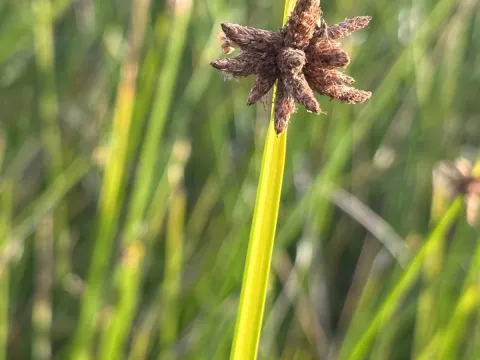
American bulrush
Schoenoplectus americanus
The planting of the American bulrush (Schoenoplectus americanus) is primarily conducted through vegetative propagation by dividing rhizomes or transplanting nursery-grown seedlings. The optimal time for this is early spring, once the water temperature begins to rise.
What the section contains
American bulrush
Successful establishment requires firm contact between the root system and the substrate. When setting up large-scale plantations, planting in a staggered pattern is recommended to ensure even distribution and rapid colonization of the aquatic area.
Propagation by seeds is possible but more challenging due to the specific cold stratification requirements of the seeds. They need to experience a period of damp, cold conditions to break dormancy, which mimics the natural overwintering process.
Planting density depends on the intended use. For phytoremediation projects, closer spacing is used to maximize immediate nutrient uptake, whereas lower densities are sufficient for biomass production.
Maintaining a stable water level is crucial for the first few weeks after planting. Ensuring that the young plants are not fully exposed to drying air or excessive waves is key to early success.
The American bulrush, a member of the Cyperaceae family, is a true hydrophyte. It thrives in well-lit, shallow waters where depth ranges from a few centimeters to about 50 centimeters.
The plant is highly adaptable to various substrates, including mud, sand, and organic-rich soils. It is particularly noted for its salinity tolerance, allowing it to colonize brackish marshes and estuaries where other plants may struggle.
Optimal growth occurs in neutral to slightly acidic pH conditions. While it is hardy, the plant prefers moderate temperature ranges and requires protection from extreme desiccation during winter if the water level drops significantly.
As a robust colonizer, the American bulrush can effectively compete for space. Its rhizomatous growth habit allows it to spread rapidly, forming dense stands that help stabilize shorelines and prevent erosion.
Environmental requirements also include adequate nutrient availability in the substrate, as the plant is highly efficient at extracting nitrogen and phosphorus from the water and soil matrix.
The biomass yield of the American bulrush is largely dependent on the nutrient content of the sediment and the amount of sunlight the stand receives. Highly productive stands can be harvested annually.
In mature, healthy plantations, the above-ground biomass production is consistent. This biomass is increasingly viewed as a renewable source for various industrial applications, including energy production.
Yield estimation is performed through trial plots, measuring dry matter weight. Understanding the productivity per square meter is essential for evaluating the economic feasibility of large-scale aquatic harvesting.
Stands typically reach peak productivity within three to four years after establishment. Regular management of the plantation ensures the long-term vitality of the rhizome mats.
Modern harvesting technologies, such as amphibious harvesters, have streamlined the process, allowing for efficient biomass collection without causing significant damage to the aquatic ecosystem.
The primary threats to American bulrush include fungal diseases such as rust and various leaf spot pathogens, which are more prevalent in stagnant water and humid environments with poor air circulation.
Pests, including various stem-boring insects and aphids, can damage the integrity of the stalks. While natural systems have a degree of resilience, severe infestations can reduce overall biomass quality.
Pollution, specifically heavy metals and excess pesticides from agricultural runoff, can impair the plant’s health and reduce its capacity for nutrient filtering and phytoremediation.
Invasive species represent a significant competitive threat, potentially outcompeting bulrush for light and space in modified or degraded aquatic environments.
- Periodic health assessment of the bulrush stands.
- Water quality management and flow regulation.
- Removal of damaged or diseased plant material.
Harvesting timing is dictated by the end-use of the material. For construction purposes, such as thatch, stalks are harvested in late autumn or winter when moisture levels are at their lowest.
If harvested for fodder, the timing shifts to the active growing season, ideally before the stalks become too fibrous, ensuring the best nutritional profile for livestock.
Post-harvest handling is critical for quality control. Drying the material in well-ventilated bundles prevents mold growth and preserves the structural integrity of the stems.
Sustainable harvesting practices are encouraged, often involving leaving sections of the stand unharvested to support local biodiversity and provide habitat for native wildlife.
Transporting the harvested biomass requires careful planning, as the material can be bulky. Mechanical baling is often used to densify the material for easier handling and storage.