
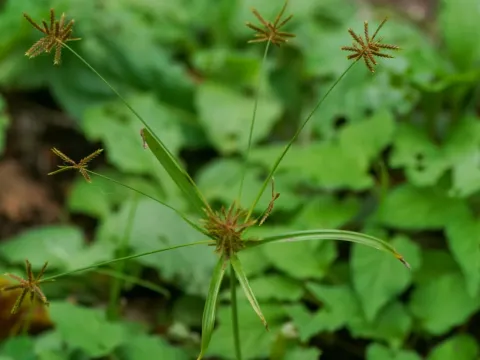
Amur sedge
Cyperus amuricus
Amur sedge (Cyperus amuricus) is a perennial herbaceous plant belonging to the Cyperaceae family. It is widely recognized in agricultural settings for its ability to thrive in wetland ecosystems, particularly in rice paddies.
What the section contains
Amur sedge
The native range of this plant includes the Russian Far East, China, Japan, and Korea, where it is often found in moist habitats, riverbanks, and marshy areas.
Botanically, the plant features a triangular stem and a robust rhizome system. These underground structures are capable of producing tubers, which serve as primary organs for vegetative reproduction.
The foliage consists of narrow, linear leaves organized in basal clusters. These leaves are adapted to environments with high humidity and significant water availability.
In agriculture, Amur sedge is often categorized as a difficult-to-control weed, as its rhizomes can withstand mechanical disturbance and quickly sprout new shoots.
The primary growth requirement for Amur sedge is high soil moisture. The plant is particularly well-adapted to anaerobic soil conditions often found in irrigated fields.
Temperature plays a crucial role in its development, with optimal growth occurring between 20°C and 28°C. Warm temperatures stimulate the rapid expansion of the root system.
Nutrient-rich, loamy soils provide the best substrate for the plant. High levels of nitrogen can lead to excessive biomass production, further increasing the competitive pressure on crops.
While tolerant of water saturation, the plant can also adapt to fluctuating water levels, making it a persistent resident in regions with seasonal flooding.
Management of this species requires a combination of cultural practices, such as crop rotation and field leveling, and the application of herbicides specifically targeting Cyperaceae species.
Amur sedge is susceptible to various rust fungi and leaf spots that thrive in humid environments. These pathogens can significantly reduce the photosynthetic capacity of the plant.
Insects such as stem-borers and aphids can cause localized damage, although the plant's high regenerative capacity often allows it to recover quickly from herbivore pressure.
Effective control in farming relies on systematic herbicide programs. Since the plant stores energy in underground tubers, foliar treatments must be translocated effectively to these organs.
Improper cultivation techniques, such as shallow tilling, can inadvertently promote the spread of the plant by fragmenting the rhizomes into smaller, viable pieces.
Despite these threats, the species maintains a high degree of survival, largely due to its physiological plasticity and the resilience of its vegetative propagation organs.