
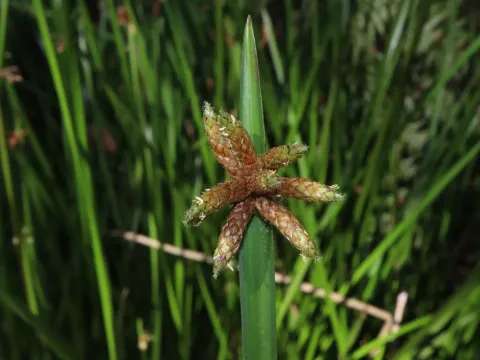
Schoenoplectiella
Schoenoplectiella
Schoenoplectiella, belonging to the Cyperaceae family, is a specialized crop with sowing dates strictly dictated by water temperature. Seeding or rhizome planting should occur in spring once water temperatures in the cultivation zone reach 12–15 degrees Celsius.
What the section contains
 Bog bulrush
Schoenoplectiella mucronata
Bog bulrush
Schoenoplectiella mucronata
 Hotaru bulrush
Schoenoplectiella hotarui
Hotaru bulrush
Schoenoplectiella hotarui
 Juncoides bulrush
Schoenoplectiella juncoides
Prostrate bulrush
Schoenoplectiella supina
Juncoides bulrush
Schoenoplectiella juncoides
Prostrate bulrush
Schoenoplectiella supina
 Schoenoplectiella erecta
Schoenoplectiella juncea
Schoenoplectiella juncea
Schoenoplectiella lineolata
Schoenoplectiella lineolata
Schoenoplectiella perrieri
Schoenoplectiella perrieri
Schoenoplectiella erecta
Schoenoplectiella erecta
Schoenoplectiella juncea
Schoenoplectiella juncea
Schoenoplectiella lineolata
Schoenoplectiella lineolata
Schoenoplectiella perrieri
Schoenoplectiella perrieri
 Schoenoplectiella praelongata
Schoenoplectiella praelongata
Schoenoplectiella praelongata
Schoenoplectiella
In industrial setups, a direct seeding method into moistened substrate is preferred. The optimal window for planting is late April or early May, allowing the plant to acclimate before the peak vegetation period.
When using seeds, it is crucial to maintain high substrate moisture until germination. Seeds should be sown at a depth of no more than 1–2 centimeters to ensure oxygen access, while keeping the water level at the minimum necessary threshold.
Early seedling development requires stable light conditions, so dense sowing is discouraged. Optimal plant density is calculated based on anticipated rhizome spreading, which covers significant area during the first few months.
Autumn planting is not recommended due to the high risk of root system frost damage during the initial establishment phase. Agronomists plan work so that plants develop a robust crown node before the first frost.
This crop is an obligate hydrophyte requiring constant water in the root zone. Ideal soil consists of silty, well-aerated bottom sediments with a neutral to slightly acidic pH level.
Schoenoplectiella has high light requirements; cultivation sites must be open and shielded from shading by trees or structures. Lack of light severely impairs biomass synthesis and stem structural integrity.
Normal growth requires temperatures between 20–28 degrees Celsius. The plant reacts poorly to sharp water temperature fluctuations, so the water body depth should be sufficient to buffer thermal changes in the root zone.
The plant prefers nutrient-rich soils, particularly those high in organic matter and nitrogen. Agronomic maintenance may include mineral fertilization, though excess chemicals in water are forbidden due to eutrophication risks.
Moisture requirements are the defining factor: even brief drying of the substrate leads to growth inhibition and reduced fiber quality. A stable hydrological regime is the foundation of high productivity.
The green biomass yield of Schoenoplectiella depends on the intensity of agronomic practices and planting density. With optimal moisture and light exposure, yields of dry matter can reach high levels.
Timely fertilization during the active stem-growing phase is a key factor in productivity. A balanced macro-nutrient application allows for a 15–20% increase in fiber output over a single season.
Yield levels are also determined by the density of productive stems per square meter. Agronomists aim to create a uniform stand that minimizes internal competition and allows for efficient resource utilization.
The second and subsequent years often show superior yields due to the establishment of dense turf and expansive root systems, which extract mineral nutrients more effectively from bottom sediments.
Experimental plots demonstrate significant potential, with peak dry biomass accumulation occurring by the end of August. Professional care ensures consistently high yields of technical raw materials.
Schoenoplectiella is susceptible to fungal pathogens that thrive in high-moisture environments. Rust species are the most dangerous, attacking the stem and disrupting photosynthesis.
Significant damage is caused by larvae of various leaf-mining insects that tunnel through the stem parenchyma, leading to reduced stem strength and premature lodging.
Biological control methods are used, as harsh chemical pesticides are often restricted in aquatic ecosystems. Crop rotation and water level management are the most effective preventive measures.
Root rot can occur during water stagnation and the accumulation of decaying organic matter. Regular sanitary cleaning of the water body to remove dead plant debris is mandatory to prevent disease spread.
Competing weeds are a serious threat during early development. Timely thinning and monitoring allow for the mitigation of any negative impact from invasive or competitive flora.
Harvesting takes place at the end of the vegetation period when fiber accumulation reaches its maximum. At this time, stems become resilient, and their color turns uniform, indicating technical maturity.
Mechanical harvesting is performed using specialized cutters adapted for wet conditions. It is vital to cut stems close to the base without damaging the rhizome, ensuring regeneration for the following year.
After harvesting, raw material requires immediate drying to prevent decay. In natural conditions, drying is conducted in loose sheaves under a shelter, which preserves fiber structure and prevents mold.
Economic uses include the production of natural weaving materials, bio-composites, and wetland restoration for shoreline reinforcement. Fiber quality directly depends on adhering to harvest schedules.
Post-harvest processing includes sorting materials by length and stem diameter, which determines their specific application in either industrial or artisan sectors.