
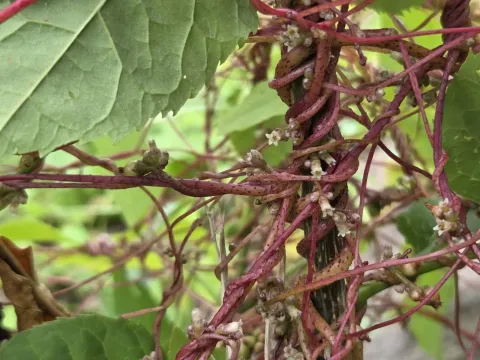
Alfalfa dodder
Cuscuta lupuliformis
Alfalfa dodder (Latin: Cuscuta lupuliformis) is a parasitic plant belonging to the Convolvulaceae family. It is characterized by a lack of chlorophyll and roots, making it an obligate parasite that derives all necessary nutrients and water from host plants.
What the section contains
Alfalfa dodder
The native range of this species extends across Eurasia, from Europe to Central Asia. It typically inhabits moist areas, shrublands, and agricultural landscapes, where it spreads rapidly by wrapping its filiform stems around the host stems.
The plant has strict environmental requirements. Its germination is highly dependent on humidity levels and the presence of a host plant nearby, which it senses through chemical signals. Once attached, it forms haustoria, which penetrate the host's vascular bundles.
Regarding agrotechnology, the primary challenge is the prevention of seed contamination in crop harvests. The seeds of Cuscuta lupuliformis are robust and can remain viable in the soil for years, making eradication a long-term process for agricultural producers.
There is no positive agricultural use for this plant; it is considered a severe quarantine weed globally. It interferes with crop metabolism, causing severe stunting and significant yield losses in diverse agricultural settings.
The main threats posed by this parasite include direct nutrient depletion and the transmission of various plant viruses. Because the dodder connects different plants, it facilitates the rapid spread of viral pathogens throughout the field.
Management strategies involve strict seed certification, quarantine measures, and the use of pre-emergent or post-emergent herbicides in specific cases. Cultural control methods, such as deep plowing and crop rotation with non-host species, are highly recommended.