
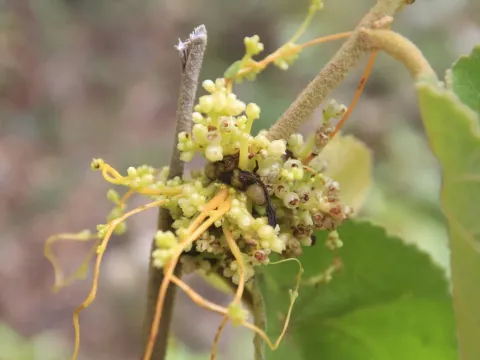
American dodder
Cuscuta americana
American dodder (Cuscuta americana) is an obligate parasitic plant species belonging to the Convolvulaceae family. Lacking chlorophyll, this organism cannot produce its own energy through photosynthesis and relies entirely on host plants for water, minerals, and organic nutrients to survive and propagate.
What the section contains
American dodder
Native to the regions of Central and South America and the Caribbean, this species has gained a reputation as a highly invasive weed. It is strictly regulated as a quarantine organism in many parts of the world due to its capacity to devastate both agricultural crops and native wild vegetation.
The morphology of the plant is characterized by slender, twining stems that lack leaves. Upon germination, the seedling seeks a host; once attached, it develops haustoria—specialized structures that penetrate the vascular tissue of the host plant, effectively draining its resources and structural integrity.
This parasite thrives in warm and humid climates, which are optimal for its rapid growth and reproduction. It is not dependent on specific soil types because it functions independently of the soil once it has successfully established a parasitic connection to a host plant, focusing its energy entirely on proliferation.
Agricultural management is intensive and focuses on prevention and containment. Key strategies include the inspection of seed batches to prevent contaminated dispersal, the use of targeted herbicides to manage infestations, and the immediate destruction of affected plant areas to stop the spread of seeds.
American dodder is a severe threat to crop production as it drastically stunts growth, reduces seed yield, and often leads to the total loss of infected fields. Furthermore, it serves as a bridge for the transmission of various viral and phytoplasma diseases between susceptible host plants.
There is no economic or agricultural value for this species, as it is strictly regarded as a harmful pest. The primary challenge remains the long-term survival of its seeds in the soil, requiring multi-year monitoring of infested lands to ensure that new generations do not re-emerge and jeopardize future crops.