
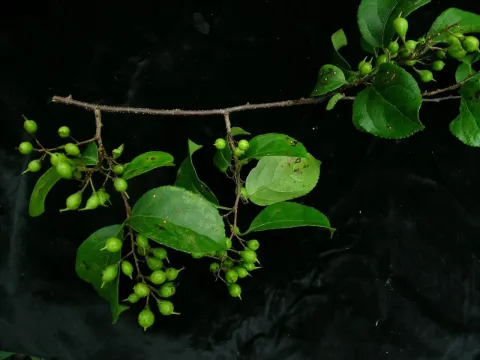
Hooker's bittersweet
Celastrus hookeri
The propagation of Celastrus hookeri in cultivation is most effectively achieved through seeds or vegetative methods such as stem cuttings. Seeds require a period of stratification at low temperatures for two to three months to break dormancy and ensure a high germination rate in the spring.
What the section contains
Hooker's bittersweet
The optimal time for sowing seeds in open ground is late autumn, allowing for natural stratification throughout the winter. For container propagation, seeds are sown in early March, keeping the substrate consistently moist until germination occurs.
Cuttings are best taken during the summer months, utilizing semi-hardwood shoots of the current year. To encourage successful rooting, it is recommended to use rooting hormones and maintain high humidity levels within a greenhouse or propagator environment.
Transplanting young seedlings to their permanent location should be conducted in the spring once the ground has completely thawed and warmed up. Given the species' well-developed root system, the planting hole should be spacious enough to accommodate the root ball without restriction.
When selecting a site, it is crucial to avoid areas with high water tables, as poor drainage leads to root rot. Well-drained soil and a location protected from cold, desiccating winds are preferred for establishing healthy plants.
Hooker's bittersweet is a member of the Celastraceae family and serves as a robust, woody climber. Its natural habitat is found in the mountainous regions of Eastern Asia, particularly the Himalayas, where it has adapted to temperate climatic conditions.
To thrive, the vine requires fertile, loose, and well-aerated soil with a neutral to slightly acidic pH. The plant is sensitive to heavy clay soils, where poor aeration and water retention can negatively impact root vitality.
The plant prefers sunny or partially shaded spots. While it possesses the ability to tolerate deeper shade, a lack of sufficient light will result in reduced growth rates and less vibrant autumnal leaf coloration.
A primary requirement for this species is the provision of sturdy structural supports. Without proper trellising, the vine will sprawl along the ground, which hinders optimal vegetative development and detracts from its overall ornamental appeal.
This species exhibits moderate frost hardiness, consistent with plants adapted to high-altitude environments. However, during particularly harsh winters without snow cover, providing a layer of mulch around the base of young specimens is recommended.
The ornamental use of Hooker's bittersweet is primarily centered on vertical landscaping and garden design. It is highly valued for its rapid growth, making it an excellent choice for screening facades, walls, and fencing within a short timeframe.
The plant produces distinct seed capsules featuring bright orange-red arils that persist on the branches long after leaf fall. This decorative feature makes the plant sought after for use in floral arrangements and winter garden aesthetics.
In commercial nurseries, Celastrus hookeri is cultivated as a landscaping specimen for urban greening projects. The success of the crop depends on proper horticultural practices and the precision of formative pruning techniques.
The plant also contributes to ecological balance through its role as a nectar source. During the flowering phase, it attracts a variety of pollinators, thereby increasing local biodiversity in the surrounding landscape.
Beyond its aesthetic value, this climber can be employed for slope stabilization and soil erosion control in specific regions, thanks to its extensive and vigorous root structure that helps bind the soil.
Celastrus hookeri is generally resilient against most common garden diseases. However, improper site management, particularly soil waterlogging, can trigger the development of various fungal root rots.
Among pests, sucking insects such as aphids and scale insects pose the most significant threat, often attacking soft growth during the active vegetation period. Regular monitoring is essential for the early detection and management of pest infestations.
If an infestation occurs, the use of systemic insecticides is recommended. It is vital to adhere to application rates specified on labels to ensure effective control without causing phytotoxic stress to the plant's foliage.
Fungal leaf spot diseases may occur in conditions of poor air circulation or overcrowding. Implementing proper spacing and carrying out sanitation pruning in the spring helps mitigate these risks and promotes better airflow.
Preventative measures involve maintaining a weed-free area around the base and applying phosphorus-potassium fertilizers to boost the plant's overall resilience against environmental stressors.
Harvesting the decorative stems with seed capsules is carried out in late autumn, ideally following the first frost. This timing is critical, as it ensures that the leaves have naturally fallen and the capsules have reached full maturity.
It is important to use sharp, clean secateurs to avoid unnecessary damage to the structural branches of the vine. Cut stems should be bundled carefully to prevent mechanical damage or premature loss of the decorative fruit.
Storage should take place in a cool, well-ventilated location with low humidity to prevent fungal growth on the capsules. This environment helps preserve the vibrant colors of the fruit throughout the winter months.
For seed collection, the capsules should be dried at room temperature. Once they have opened, the seeds are easily extracted and can be stored in paper envelopes, maintaining viability until the next sowing season.
During harvesting, it is necessary to leave a portion of the growth on the vine to ensure natural self-seeding and the continued health of the mature specimen. Over-harvesting or excessive pruning can deplete the plant's reserves for the following year.