
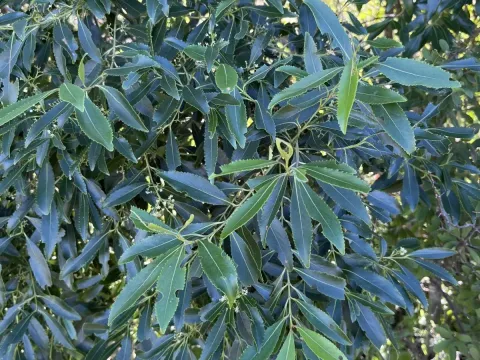
Khat
Catha Forssk. ex Scop.
Propagation of khat is primarily achieved through cuttings, as the seeds have a very short lifespan and must be sown immediately after collection. Cuttings are typically started in protected nursery environments with high humidity and stable temperatures around 20–25 degrees Celsius.
What the section contains

Khat
For seed sowing, a light and well-draining substrate rich in organic matter is essential. Maintaining consistent moisture is crucial, but one must avoid waterlogging, which can rapidly lead to root rot and the loss of sensitive young seedlings.
Seedlings develop slowly and require careful attention during the initial growth stages. In natural conditions, growth accelerates with the onset of seasonal rains, so artificial irrigation must be carefully managed to mimic these natural cycles until the plant is established.
In cooler climates, khat must be grown exclusively in greenhouses or indoor settings as it is frost-intolerant. Supplemental LED lighting is often necessary during the winter months in indoor environments to maintain adequate photosynthetic rates for healthy plant growth.
Soil preparation involves deep tillage and the incorporation of compost to improve nutrient levels and soil structure. In commercial plantations, spacing of 1.5 to 2 meters between plants is standard, allowing sufficient airflow to minimize the development of fungal diseases.
Khat (Catha edulis) is a slow-growing evergreen shrub or small tree belonging to the Celastraceae family. It is native to the mountainous regions of East Africa and the Arabian Peninsula, where it has evolved to thrive in high-altitude environments.
The plant performs best at elevations between 1500 and 2500 meters, preferring climates with moderate daytime temperatures and cool nights. Such conditions are essential for the plant to concentrate secondary metabolites within its leaves, which define its agricultural value.
Khat requires well-drained, slightly acidic to neutral soils. Heavy clay soils are unsuitable unless amended with sand or organic matter, as poor drainage is the most common cause of plant failure in non-native cultivation areas.
Adequate sunlight is necessary for optimal development, although young plants may require partial shade in extremely hot climates to prevent leaf scorch. High-intensity light exposure is generally correlated with higher quality leaves during the harvesting phase.
Air humidity should be maintained at moderate levels, ideally between 60% and 70%. In arid regions where khat is cultivated, drip irrigation systems are highly recommended to provide precise water delivery while keeping the canopy dry to reduce disease pressure.
Yields of khat are highly dependent on the plant's age, pruning frequency, and overall crop management. Mature shrubs typically reach peak productivity after three to five years, providing a consistent supply of leaves throughout the growing season.
Strategic pruning is the most significant factor in managing yield. By regularly removing the tips of branches, growers stimulate the growth of new, tender shoots, which are the most valuable parts of the plant and contribute to a higher biomass output.
The quality of the harvest is closely linked to soil fertility and water management. Adequate nitrogen and phosphorus supply ensures the development of lush, soft leaves, whereas drought-stressed plants produce tougher, less desirable foliage that carries lower market value.
Under professional management, a well-maintained plantation can remain productive for several decades. Growers must ensure consistent nutrient replenishment through fertilization to prevent soil depletion and sustain stable harvest cycles over the long term.
After harvesting, the biomass is highly perishable. Effective post-harvest management involves cooling the product immediately to prevent wilting and degradation, which can render the crop unsalable within hours if not properly handled.
Khat is susceptible to various pests, most notably aphids and spider mites, which feed on the tender young shoots. Integrated pest management strategies, including the use of neem oil or targeted biological controls, are preferred to maintain crop safety.
Fungal diseases, such as root rot caused by Phytophthora species, represent a major threat, particularly in poorly drained soils. The infection manifests as sudden wilting, and once systemic, it is often impossible to save the affected individual shrubs.
Leaf spot diseases, often triggered by prolonged humidity and lack of canopy airflow, can severely impact the quality of the marketable leaves. Regular inspection and the removal of infected plant tissue are standard practices for disease control in plantations.
Root-knot nematodes can cause significant damage in sandy soils, leading to stunted growth and reduced vigor. Crop rotation and the use of nematode-resistant soil amendments are critical for long-term plantation health in infested geographic areas.
Viral infections, typically transmitted by insect vectors, can cause leaf deformation and severe growth inhibition. Strict control of aphid populations and the immediate removal of symptomatic plants are essential to prevent the spread of viruses throughout the crop.
Harvesting khat is a labor-intensive, manual process. Workers carefully select and snap off the terminal shoots and the youngest leaves, ensuring that the older, woody branches remain intact to support future growth and plant structure.
The optimal time for harvest is early morning, when the plant's turgor pressure is at its peak. Harvesting during the cooler hours helps to maintain the moisture content of the leaves, which is vital for post-harvest freshness and marketability.
Immediately after harvest, the leaves are sorted by grade and size, with any discolored or damaged material being discarded. Maintaining consistent quality standards during the sorting phase is crucial for achieving better prices in wholesale markets.
Tools used for harvesting must be kept sharp and disinfected between rows to avoid the mechanical transmission of pathogens. Careful handling ensures that the plant recovers quickly and produces a new flush of growth for the next harvest cycle.
Storage of the harvested product is the final critical step. Leaves are typically bundled and wrapped in moisture-retaining materials, such as fresh banana leaves, before being placed in climate-controlled transport boxes to reach the consumer in optimal condition.