
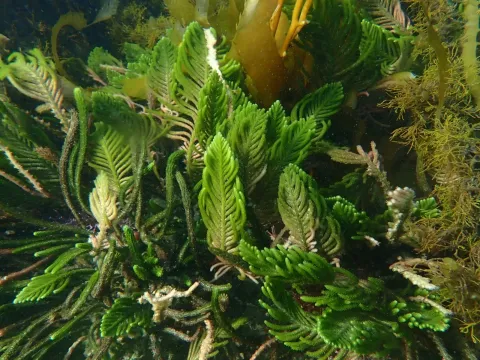
Caulerpa
Caulerpa
Caulerpa is a genus of siphonous green algae widely cultivated in marine agriculture. Unlike traditional crops, it does not propagate via seeds but rather through vegetative fragmentation of its thallus, which acts as a giant multinucleate cell.
What the section contains


Caulerpa
Cultivation starts by anchoring small, healthy fragments of the algae onto specialized substrate grids. These fragments are placed in water columns where they begin to spread rapidly across the available surface area.
Proper spacing during the initial planting phase is critical to ensure that each fragment receives sufficient nutrients and light. This density management prevents early competition and promotes uniform growth across the entire farming area.
The planting process is designed to mimic natural growth, where rhizoids eventually penetrate or grasp the substrate to secure the plant. Once established, these structures can withstand moderate water currents.
Agronomic efficiency relies on the regenerative capacity of the species. Even small sections of the thallus have the potential to grow into new, fully developed colonies, making the propagation process highly sustainable.
Caulerpa thrives in tropical marine environments, requiring stable water temperatures between 25 and 30 degrees Celsius. High intensity of solar radiation is essential for photosynthesis and the rapid accumulation of biomass.
The water must have a salinity level of 30–35‰ to maintain osmotic balance. Fluctuations outside this range can severely stress the plant, leading to stunted growth or tissue decay.
Adequate water circulation is vital to provide consistent nutrient flow, including nitrogen and phosphorus. However, high-quality management is needed to prevent the bloom of invasive epiphytic algae that compete for resources.
The chosen site for a Caulerpa farm must have clear, unpolluted water, as the algae are sensitive to heavy metals and chemical contaminants, which can affect its safety for food consumption.
Monitoring pH levels and nutrient concentrations in the water column is standard practice in successful mariculture, ensuring optimal physiological conditions for the development of the thallus.
Under optimal conditions, Caulerpa exhibits extremely high growth rates, capable of doubling its total biomass within two weeks. This rapid cycle makes it an exceptionally productive crop for commercial aquaculture.
Yield efficiency is significantly improved by utilizing vertical farming systems, which maximize the use of the water column and allow for more intensive management compared to traditional shallow-water methods.
Strategic harvesting cycles ensure continuous production. By removing only a portion of the biomass, farmers stimulate faster regeneration of the remaining plant, maintaining high yields over long periods.
In controlled environment settings, such as recirculating aquaculture systems, yields can be even more predictable due to the precise regulation of temperature, light, and nutrient inputs.
Successful management allows for multiple harvest cycles throughout the growing season, providing a stable and reliable supply of this nutritious marine vegetable to the market.
Commercial Caulerpa farms are susceptible to herbivory by marine fauna, specifically sea urchins, certain gastropods, and surgeonfish, which can graze on the thalli and destroy large sections of the crop.
Pathogenic bacterial infections can cause localized decay and discoloration, often referred to as 'melting,' which occurs when the plant's structural integrity fails due to stress or poor conditions.
Competition from invasive algal species is a major threat. These opportunistic plants can overgrow the Caulerpa, effectively choking it by restricting access to light and nutrients.
Climatic stressors, particularly extreme temperature fluctuations, are major concerns. A rise in water temperature above the threshold can lead to rapid cellular collapse and large-scale crop loss.
- Primary pests: Sea urchins, herbivorous fish.
- Diseases: Bacterial necrosis, chlorosis.
- Environmental issues: Epiphytic algae overgrowth.
Harvesting Caulerpa is a labor-intensive process performed manually to protect the delicate texture of the fronds. This ensures the high-quality, aesthetic appearance required for its popular use as 'sea grapes.'
Immediately after harvest, the product must be cleaned of debris and potential contaminants. This post-harvest processing is crucial to meeting strict food safety standards.
Logistics for Caulerpa are demanding, as the fresh product has a very short shelf life. It must be kept in humid, temperature-controlled containers to prevent dehydration and enzymatic degradation.
Transport networks must be efficient, maintaining a strict cold chain from the farm to the end consumer to preserve the signature 'pop' and freshness of the vesicles.
Proper harvesting techniques ensure that the root-like stolons remain intact, which is essential for the rapid recovery and continued growth of the colony in the next production cycle.