
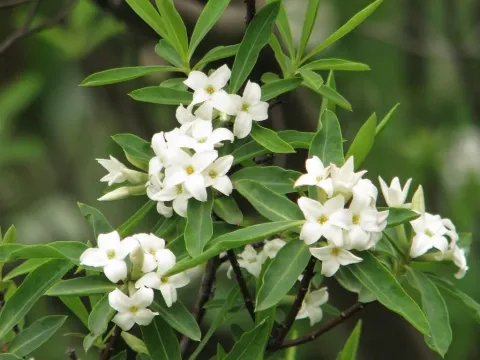
Caucasian daphne
Daphne caucasica
Caucasian daphne (Daphne caucasica) is a perennial deciduous shrub belonging to the Thymelaeaceae family. Native to the Caucasus region, it is naturally adapted to mountain forests and rocky slopes, where it grows as an understory or edge species.
What the section contains
Caucasian daphne
The plant features a stiff, upright growth habit, typically reaching up to 1.5 meters in height. Its foliage is lanceolate and dark green, providing a lush appearance. In spring, it produces clusters of fragrant, pure white flowers that are highly valued in horticultural practices.
For optimal growth, the species requires a sheltered position with partial shade. While it prefers cool roots, it demands well-draining soil to prevent winter waterlogging, which is a common cause of failure for this particular shrub species in garden settings.
The soil should be rich in organic matter and slightly acidic to neutral. Regular mulching is recommended to maintain constant soil moisture levels during the summer months, while also protecting the shallow root system from extreme temperature fluctuations.
Regarding its utility, the Caucasian daphne is used primarily as an ornamental specimen in gardens and landscapes. It is prized for its early spring fragrance, although gardeners must handle the plant with care as all parts of the shrub are toxic to humans and animals.
The plant is susceptible to fungal infections such as root rot and leaf spot. Proper spacing and airflow are critical to minimize these risks, especially in regions with high humidity levels during the growth season.
Common pests include aphids and spider mites, which can cause significant damage to the foliage. Monitoring the plant regularly is essential, and applying biological or chemical controls is recommended at the first signs of infestation.