
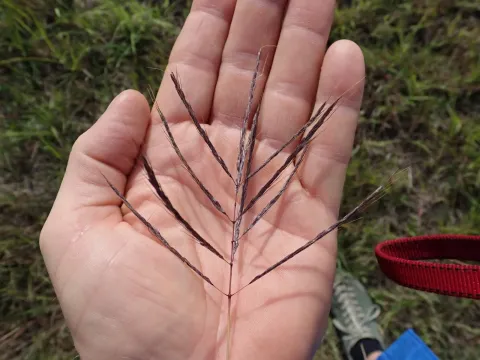
Caucasian bluestem
Andropogon caucasicus
Sowing of Caucasian bluestem is best performed in the early spring, as soon as the soil has sufficiently warmed and retains winter moisture. This early start ensures robust root development before the onset of summer heat.
What the section contains
Caucasian bluestem
Seeds should be planted at a shallow depth of 1–2 centimeters, given their small size. Proper seed-to-soil contact is essential for uniform germination, which can be achieved through light rolling after sowing.
Fall seeding is also an option in regions with mild winters, allowing the seeds to undergo natural stratification. This technique often results in more vigorous spring growth and better establishment of the stand.
Field preparation must focus on eliminating existing weed populations. Because Caucasian bluestem establishes somewhat slowly during its first year, it requires a weed-free environment to thrive without competition.
The seeding rate should be optimized based on the desired use of the stand. Higher densities are usually preferred for dense grazing pastures, while slightly lower rates are sufficient for hay production fields.
Caucasian bluestem, a member of the Poaceae family, is a perennial grass highly adapted to arid and semi-arid environments. It is renowned for its exceptional drought tolerance and heat resistance.
The crop performs best in well-drained, light-textured soils such as sandy loams. One of its most valuable traits is the ability to tolerate saline soil conditions, where it often outproduces other forage grasses.
The species requires full sunlight to achieve maximum biomass production. It is not shade-tolerant and will perform poorly if established in areas with significant competition or dense canopy cover.
With a deep, fibrous root system, this grass effectively extracts water and nutrients from the deeper soil profiles. This efficiency minimizes the need for high-frequency irrigation or excessive chemical fertilizers.
While adapted to harsh climates, the best growth is observed under moderately warm conditions with periodic moisture. It is a highly reliable plant for land reclamation and soil conservation projects.
The biomass yield of Caucasian bluestem is strongly correlated with the availability of nitrogen and adequate moisture during the growing season. Under managed conditions, it provides consistent and stable forage.
In regions with sufficient water, the crop can support two full cuttings per season. To maintain high forage quality, it is critical to harvest before the plant enters the reproductive stage.
The nutritional profile of the hay is excellent if harvested during the vegetative phase. As the plant matures and produces inflorescences, the stems become fibrous, leading to reduced palatability for livestock.
Caucasian bluestem is highly regarded for its ability to recover after intensive grazing. Its growth habit allows it to maintain a productive stand even under high stocking rates in drought-prone areas.
Seed production yields are highly dependent on favorable late-summer weather. Harvesting should be carefully timed to match seed maturity, ensuring high quality and germination potential for future plantings.
Caucasian bluestem is naturally resistant to most common grass diseases. This intrinsic hardiness significantly lowers production costs by reducing the need for fungicide applications throughout the year.
Weed competition remains the primary threat, particularly during the establishment year. Integrated weed management, including early-stage mechanical control or selective herbicides, is recommended for best results.
While generally pest-free, local populations of aphids or grass-feeding insects can occasionally appear. Regular scouting during the early vegetative phase is advised to determine if intervention is necessary.
Root rot issues are typically restricted to sites with poor soil aeration or persistent standing water. Selecting well-drained sites for planting is the most effective preventative measure against these issues.
The overall simplicity and resilience of Caucasian bluestem make it a low-maintenance, high-reward crop for farmers looking to establish reliable forage bases in challenging environmental conditions.
Hay harvesting should be conducted at the onset of flowering. This stage provides the optimal compromise between total biomass yield and the digestibility of the forage for cattle and livestock.
Stubble height should be maintained at roughly 5–7 centimeters. This preserves the crown of the plant, protecting it from damage and facilitating rapid regrowth for subsequent cuts or grazing cycles.
The forage dries relatively quickly after cutting, which is a major advantage for hay quality. Using modern mower-conditioners can further accelerate the curing process, preserving more of the plant's nutrients.
Seed harvest requires attention to the timing of maturity to avoid seed shattering. Using combines set to moderate speeds ensures that the maximum amount of seed is captured during the harvest operation.
Post-harvest processing involves cleaning and drying the seeds to a moisture content of 12–14%. Proper storage conditions in a cool, dry environment will maintain high seed viability for the following season.