
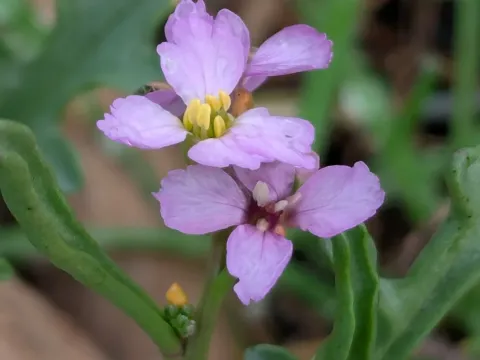
Sea rocket
Cakile
Sea rocket belongs to the Brassicaceae family. It is a succulent annual herb primarily found on sandy beaches and coastal dunes, where it thrives in harsh saline conditions.
What the section contains


Sea rocket
The plant features fleshy, lobed leaves that are adapted to minimize water loss, and a branched stem structure that supports its growth in loose, shifting sands.
As a halophyte, Cakile is exceptionally well-adapted to high salt concentrations in the soil, which would be toxic to most other agricultural or wild crops.
The plant requires full sun exposure and nutrient-poor, well-drained sandy soils. It cannot survive in stagnant water or clay-heavy environments where aeration is insufficient.
Its reproductive cycle is highly dependent on ocean dispersal, as the seed pods remain buoyant in seawater, allowing the plant to colonize new stretches of coastline.
Cakile species are susceptible to pests common to the mustard family, with flea beetles being the most frequent threat to seedlings during the early growth stages.
Fungal infections such as downy mildew can develop in environments with excessive moisture, causing yellowing and wilting of the foliage in dense populations.
Coastal erosion represents a major environmental threat, as storms can physically uproot the plants and destroy their limited habitats along the shoreline.
Competition from invasive plant species can crowd out sea rocket populations, particularly in areas where human activity has altered the natural sand dune stability.
Pollution from maritime traffic and oil spills can contaminate the substrate, directly inhibiting the germination process of the seeds resting in the sand.