
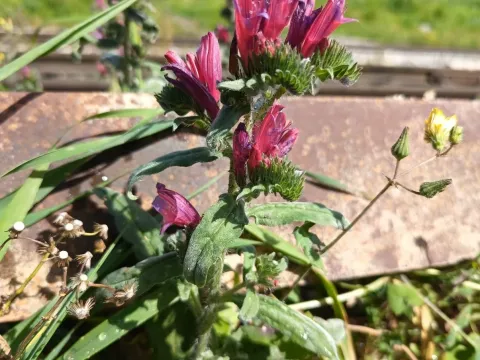
Cretan viper's bugloss
Echium creticum
Cretan viper's bugloss (Echium creticum) is an annual or biennial herbaceous plant belonging to the Boraginaceae family. It is native to the Mediterranean region, where it has evolved to thrive in semi-arid environments and impoverished rocky soils.
What the section contains
Cretan viper's bugloss
The sowing season varies depending on the climate zone; however, in regions with mild winters, autumn sowing is preferred to ensure early spring establishment. In colder climates, early spring sowing is more suitable once the soil temperature allows for germination.
The seeding rate typically ranges from 3 to 6 kg per hectare, depending on the chosen sowing method—drilled rows are often preferred to facilitate mechanical weeding. Seed depth should be kept shallow, at approximately 1-2 cm, to ensure successful emergence.
Seedbed preparation is vital: the soil should be fine-textured to ensure good contact between the seeds and the soil surface. Rolling the field after sowing can significantly increase the emergence rate by maintaining soil moisture around the seeds.
The crop establishes a deep taproot early on, which makes it resilient during the vegetative phase. Proper spacing is necessary to allow each plant to reach its full flowering potential, as overcrowding can lead to reduced nectar production.
This species is highly photophilous and requires full sun exposure to flourish. It should not be planted in shaded areas, as lack of light negatively impacts both the vegetative growth and the intensity of floral development.
Echium creticum is tolerant of a wide range of soil types, including sandy, stony, and clay-loam soils. It thrives in well-drained conditions, as excessive moisture often leads to root rot, which is a major limiting factor for this crop.
The optimal soil pH range is between 6.5 and 8.0. While the plant is drought-tolerant, it will respond positively to intermittent irrigation during the early growth stages, provided that the soil drainage is sufficient to prevent waterlogging.
The plant exhibits high thermal adaptability, being able to survive heatwaves typical of Mediterranean climates. However, prolonged frost during the early budding stage can cause minor damage, though mature plants are relatively hardy.
Nutrient requirements are relatively low compared to high-intensity crops. Excessive nitrogen fertilization should be avoided, as it encourages excessive leaf growth at the expense of floral nectar production, which is usually the primary commercial goal.
The primary economic use of Cretan viper's bugloss is its role as a high-quality honey plant. It produces abundant nectar that is highly attractive to honeybees, significantly increasing the productivity of local apiaries and the quality of the resulting honey.
Beyond honey production, the seeds of E. creticum are rich in valuable fatty acids, particularly gamma-linolenic acid (GLA), making it a potential industrial crop for the production of specialized pharmaceutical and cosmetic oils.
In environmental management, the plant is used for soil erosion control on slopes. Its deep root system stabilizes the soil profile, while its ability to grow in degraded areas makes it an excellent choice for land reclamation projects.
As a green manure crop, it contributes significantly to soil organic matter. Incorporating the biomass before seed set helps improve soil structure and increases nitrogen availability for subsequent crops in the rotation cycle.
Finally, its contribution to biodiversity cannot be overstated. By serving as a major food source for pollinators, it enhances the overall ecological stability of the farm, often resulting in higher yields for neighboring entomophilous crops.
Echium creticum is generally robust and less prone to major pest outbreaks than many other agricultural crops. However, powdery mildew can occur under conditions of high humidity or poor air circulation within the canopy.
Root rot is the most common disease threat, particularly in poorly drained or waterlogged soils. Prevention involves site selection and the implementation of drainage techniques rather than chemical fungicide applications.
Occasional infestations of aphids may be observed on tender shoots. Due to the presence of honeybees, the use of broad-spectrum insecticides is strongly discouraged; instead, integrated pest management (IPM) using biological control agents is recommended.
Some chewing insects might affect the foliage, but these injuries rarely reach an economic threshold. Consistent field monitoring is the best strategy to manage these occurrences without resorting to heavy chemical intervention.
Crop rotation remains the fundamental pillar of disease management for this species. To prevent the build-up of host-specific pathogens in the soil, it is advised to rotate E. creticum with unrelated crop species every 3 to 4 years.
Harvesting for seeds requires precision because the plant ripens progressively along the flower spike. Harvesting should commence when the seeds in the lower parts of the spike turn dark brown, just before they begin to shatter naturally.
A two-stage harvesting method is often the most efficient: cutting the crop and leaving it in swaths to dry for a few days before threshing. This practice allows the remaining seeds to reach physiological maturity, maximizing yield quality.
Post-harvest cleaning of the seeds is necessary to remove floral residues. Seed processing machinery should be adjusted to minimize mechanical damage to the seed coat, which is important for maintaining viability during long-term storage.
If harvested for biomass (green manure), the crop is cut during the mass flowering stage using standard forage harvesters. At this stage, the plant has optimized its nutritional content for soil enrichment.
Seeds must be stored in a cool, dry, and well-ventilated environment. Maintaining low moisture content in the storage area is critical to preventing fungal growth and ensuring the seeds retain high germination rates for future planting seasons.