
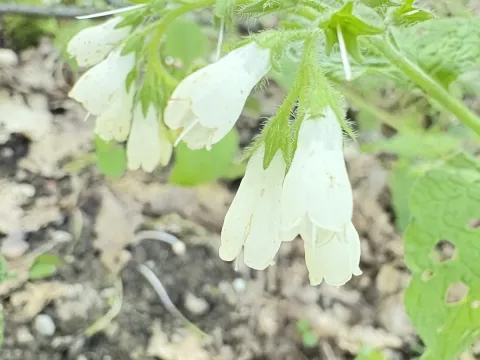
Crimean comfrey
Symphytum tauricum
Crimean comfrey (Symphytum tauricum) belongs to the Boraginaceae family. It is a perennial herbaceous plant known for its vigorous growth and deep rooting system.
What the section contains
Crimean comfrey
Seeds require cold stratification to break dormancy. For best results, sow seeds in late autumn so they undergo the necessary winter chilling in the soil naturally.
Vegetative propagation is the preferred commercial method. Root cuttings should be planted in early spring or autumn at a depth of approximately 5–8 centimeters.
When establishing a plantation, maintain rows about 60–70 centimeters apart to facilitate mechanical weeding and crop maintenance.
The plant is extremely long-lived, capable of thriving in the same field for over a decade with minimal replanting requirements.
As a Crimean endemic, the plant prefers temperate climates. It is highly drought-tolerant once established, thanks to its deep, penetrating taproots.
The ideal soil is fertile, well-drained, and rich in organic matter. Avoid heavy clay soils that stay waterlogged, as these promote root rot.
Crimean comfrey flourishes in full sun but demonstrates good shade tolerance, making it an excellent choice for agroforestry and orchard understories.
While adaptable to various soil pH levels, it performs best in neutral to slightly alkaline conditions where mineral uptake is optimal.
The crop is frost-hardy and survives harsh winters provided it is established, making it suitable for a wide range of temperate geographic regions.
The foliage yield is impressive, with the plant capable of producing 2–3 harvests per season when managed under intensive conditions.
Harvesting for biomass should occur during the flowering stage to ensure the highest concentration of minerals, particularly potassium and nitrogen.
The biomass serves as a premium liquid fertilizer or green manure, significantly improving soil structure and microbial activity in the field.
Productivity peaks from the third year onwards as the root system expands to fully occupy the available soil profile.
By effectively mining nutrients from deep soil layers, the plant acts as a natural soil improver for subsequent shallow-rooted crops.
Crimean comfrey is generally robust, but high humidity can lead to powdery mildew outbreaks if plant spacing is too dense.
Common agricultural pests like aphids or leaf-eating beetles may appear during the growing season, though they rarely cause economic thresholds of damage.
Root rot is the primary threat in poorly drained soils. Maintaining proper field drainage is the most effective preventative measure for farmers.
Competition from aggressive perennial weeds can hinder young plants, so early-stage weed management is crucial for successful establishment.
Crop rotation protocols should be followed if the plantation needs to be cleared, as fragmented roots can sprout and regenerate quite easily.
For biomass production, harvest the above-ground parts using sickle-bar mowers, ideally before the plants set seeds to maximize nutrient return.
When harvesting roots for medicinal use, perform the extraction in late autumn or early spring when the plant's active compounds are at their peak.
Dried leaves should be processed in well-ventilated sheds, avoiding direct sunlight to prevent the degradation of heat-sensitive chemical components.
Roots must be washed thoroughly to remove soil particles and sliced into small segments before mechanical drying at low temperatures.
Proper storage in dry, moisture-resistant packaging ensures the long-term stability and quality of the final agricultural product.