
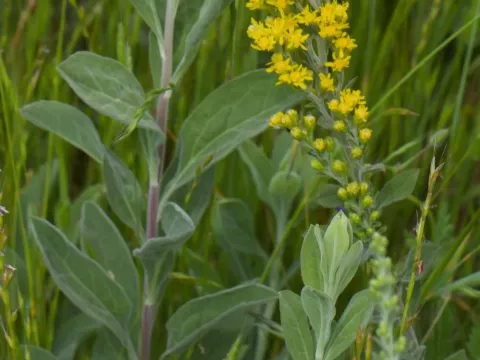
California goldenrod
Solidago californica
Sowing California goldenrod is best performed during the late autumn, allowing the seeds to undergo natural stratification throughout the winter months.
What the section contains
California goldenrod
For spring planting, seeds must be cold-stratified in a refrigerator at approximately 4 degrees Celsius for at least one month to ensure uniform germination.
Seeds should be sown at a shallow depth of no more than 0.5 centimeters, as they require sufficient exposure to light to break dormancy.
Establishing seedlings in a nursery environment before transplanting them to the field in late spring significantly improves the survival rate of the crop.
Maintaining a row spacing of 60 centimeters is recommended to facilitate equipment access and promote adequate airflow between mature plants.
California goldenrod thrives in full sun exposure, which is critical for achieving optimal biomass development and flowering intensity.
The plant is highly adaptable to various soil types, although it performs best in well-drained, sandy-loam soils with neutral acidity.
Once established, the crop exhibits excellent drought tolerance due to its extensive root system, making it suitable for low-input agricultural systems.
Watering should be managed consistently during the early growth stages, but mature plants can withstand periods of limited precipitation.
The species is hardy and well-suited for cultivation in temperate climates, showing good resistance to winter cold cycles.
Crop yields are expected to peak from the third year onwards as the rhizomatous root system fully colonizes the assigned soil volume.
For herbal production, the aerial parts are harvested during the peak blooming period when the concentration of secondary metabolites is at its highest.
Commercial yields of dry matter can range from 3 to 5 tons per hectare, depending on soil fertility and plant density management.
As a prolific nectar producer, California goldenrod serves as an excellent pollinator-friendly crop that supports local honey production.
The harvest of seeds for nursery purposes can also generate additional revenue if handled with proper cleaning and drying protocols.
Powdery mildew is the most common fungal disease, especially prevalent in high-humidity conditions with insufficient crop rotation.
Insect pests such as aphids and leaf beetles can cause significant damage to foliage, necessitating proactive monitoring during the vegetative phase.
Rust diseases may occur during wet seasons; therefore, ensuring proper plant spacing is essential to reduce moisture buildup within the canopy.
Integrated Pest Management (IPM) practices, including the use of beneficial insects, are highly effective in protecting goldenrod crops.
Avoiding overhead irrigation can significantly reduce the risk of leaf-borne infections and improve the overall quality of the harvested biomass.
Harvesting is conducted using mechanical forage harvesters, targeting the flowering stems while leaving sufficient basal growth for plant recovery.
Immediate post-harvest drying is required to stabilize the plant material and prevent the degradation of active chemical compounds by moisture.
Drying should occur in darkened, well-ventilated sheds to preserve the golden color and aromatic properties of the harvested flowers.
Seeds are harvested once the seed heads begin to fluff, typically using combines adjusted to prevent excessive damage to the delicate seeds.
Proper field maintenance after harvest involves mowing down debris to encourage strong root development for the following season's growth cycle.