
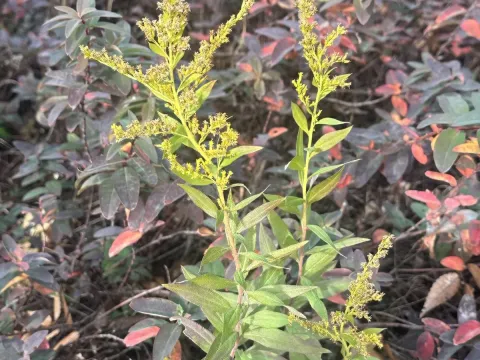
Tall goldenrod
Solidago altissima
Tall goldenrod is a resilient perennial that spreads primarily through an extensive rhizome system, making vegetative propagation the most effective method for cultivation.
What the section contains
Tall goldenrod
When starting from seeds, they require a cold stratification period to break dormancy and ensure high germination rates before spring planting.
Planting density should be carefully managed, typically spacing plants at least 60–80 cm apart to allow for proper airflow and root development.
The optimal sowing time in temperate regions is early spring, once the soil has sufficiently thawed and reached a consistent temperature.
Care must be taken to contain the planting area, as the plant's aggressive growth habit can easily lead to its spread into non-target agricultural zones.
This species is highly adaptable, thriving in a variety of soil types ranging from sandy loams to heavier clay soils, provided there is adequate moisture.
Solidago altissima performs best in full sun, where the stems are stronger and flower production is significantly higher than in shaded areas.
It is remarkably hardy, surviving harsh winters without special protection, making it a reliable perennial in diverse climatic conditions.
While tolerant of periodic dry spells, the plant responds favorably to moisture during the peak summer growing season.
Soil pH preference is broad, though slightly acidic to neutral environments favor the most vigorous development of the goldenrod stand.
Tall goldenrod is widely recognized as a valuable late-season honey plant, providing crucial nectar sources for pollinators when most other crops have finished blooming.
The biomass yield is considerable, with mature stands producing a high density of stems suitable for botanical raw material extraction.
Honey yields are heavily dependent on climatic variables during the August–September flowering window, particularly temperature and relative humidity.
Consistent annual productivity is a key advantage, as a single planting can provide sustainable harvests for several years without the need for reseeding.
Yield monitoring involves assessing both the quantity of nectar produced and the dry weight of harvested aerial parts for medicinal applications.
Powdery mildew is the most common fungal issue, typically manifesting on foliage in conditions of poor air circulation and high humidity.
Insect pests, including various aphid species and plant bugs, may affect young growth, necessitating early detection and IPM strategies.
Effective management includes maintaining proper spacing between plants and ensuring that the site is well-drained to minimize fungal risks.
Invasive management is critical, as goldenrod can displace native flora or other crops if its rhizomatous growth is not actively restricted.
While generally robust, systemic fungicides or targeted insecticides are used in commercial settings when threshold pest populations are exceeded.
The harvest of aerial parts for medicinal use takes place at the onset of flowering, when the concentration of flavonoids and other bioactive compounds is highest.
Harvesting should be done on clear, dry days to prevent moisture entrapment, which can significantly degrade the quality of the raw material.
For large-scale operations, mechanical mowing is employed, with immediate transport to drying facilities to preserve the plant's integrity.
Seed harvesting requires careful timing, typically after the flower heads turn brown but before the seeds are dispersed by the wind.
Dried material must be stored in cool, dark, and well-ventilated areas to ensure long-term stability of the extracted constituents.