
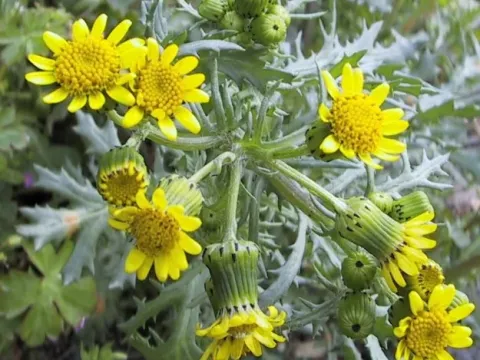
Welsh groundsel
Senecio cambrensis
Welsh groundsel (Senecio cambrensis) is a rare species within the Asteraceae family. It is recognized as an allopolyploid species that originated from the hybridization of common groundsel (S. vulgaris) and Oxford ragwort (S. squalidus).
What the section contains
Welsh groundsel
This species is not a crop and has no agricultural significance in terms of cultivation. It is primarily observed in wild populations, specifically in parts of the United Kingdom and, more rarely, in other European regions.
The plant typically colonizes man-made environments such as railway embankments, gravelly waste grounds, and disturbed urban habitats. These areas provide the open soil conditions necessary for its successful germination and survival.
Regarding environmental requirements, Senecio cambrensis favors well-drained, nutrient-poor, and stony soils. It thrives in open, sunny locations where there is minimal competition from perennial grasses or larger woody species.
Botanically, it exhibits a compact growth habit and produces characteristic flower heads typical of the Senecio genus. Its lifecycle is strictly annual, relying on rapid production and dispersal of seeds to maintain its population density in shifting environments.
The primary threats to Senecio cambrensis involve habitat destruction due to infrastructure development and site redevelopment projects in industrial areas.
Chemical control, specifically the use of herbicides on railway tracks and roadsides, poses a significant risk to local populations, often leading to total eradication in treated sections.
The species may be subject to occasional herbivory by generalist insects, although its alkaloid content generally deters most pests from causing significant physiological damage.
Pathogens like powdery mildew can affect the plant in overly damp conditions, potentially reducing seed set and overall population vigor during unfavorable growing seasons.
Competition from more aggressive, invasive non-native plant species remains a critical factor, as these plants can rapidly overtake the specific niches favored by the Welsh groundsel.