
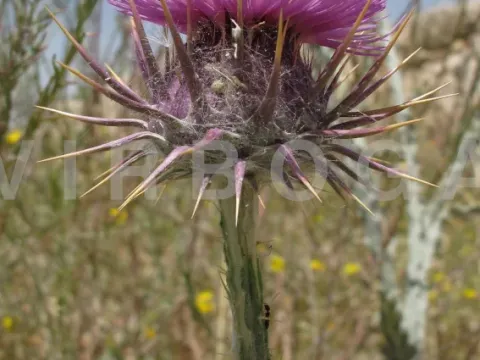
Jordan cotton thistle
Onopordum jordanicolum
Sowing of Onopordum jordanicolum should be performed in the spring when the soil temperature consistently reaches 12-15 degrees Celsius. This timing ensures rapid germination and prevents early frost damage.
What the section contains
Jordan cotton thistle
Seeds should be planted at a shallow depth of approximately 2 centimeters to provide optimal contact with moisture while allowing enough light for the seedling to emerge efficiently.
Row spacing is a critical factor for crop development. Maintaining a distance of at least 60 centimeters between rows ensures that each individual plant has sufficient space for root and leaf development.
Mechanical precision seeders are recommended for large-scale production to achieve uniform planting depth and distribution. This consistency minimizes the need for labor-intensive hand thinning later in the season.
It is advised to ensure the seedbed is well-prepared, fine-textured, and free from surface crusts, which significantly facilitates the emergence of the tender seedlings of the Jordan cotton thistle.
As a member of the Asteraceae family, the Jordan cotton thistle thrives in Mediterranean-type climates with long, sunny days. It is a highly drought-tolerant species once established in the field.
Soil requirements focus on excellent drainage. The plant grows best in sandy loam or neutral, loose soils. Heavy, clay-rich soils that retain excess moisture should be avoided to prevent root diseases.
The plant requires full sun exposure for the duration of its growth cycle. Insufficient sunlight will lead to spindly stems and reduced overall biomass, impacting the potential yield of the crop.
While the plant is hardy, providing supplemental irrigation during the most active growth phases significantly enhances crop vigor. Proper hydration prevents early senescence of the lower foliage.
Maintaining high levels of soil fertility through moderate nitrogen applications, balanced with phosphorus and potassium, will support robust flowering and vegetative development throughout the summer.
Powdery mildew is the most common fungal threat to the crop, typically appearing during humid weather or when air circulation within the plant canopy is insufficient for proper drying.
Rust diseases can also affect the plant's health, manifesting as spots on the foliage. Early intervention with fungicides or removing affected plants is necessary to preserve the health of the entire field.
Aphids often target new, tender growth at the top of the plant. If left untreated, they can cause leaf curling and attract secondary pests, which can further stress the plant and reduce its yield.
Root rot pathogens are a persistent threat in areas with poor drainage. Implementing a rigorous irrigation schedule and choosing sites with natural slopes can help mitigate this danger effectively.
- Strategic crop rotation.
- Field sanitation practices.
- Monitoring for early pest signs.
- Use of resistant varieties where available.