
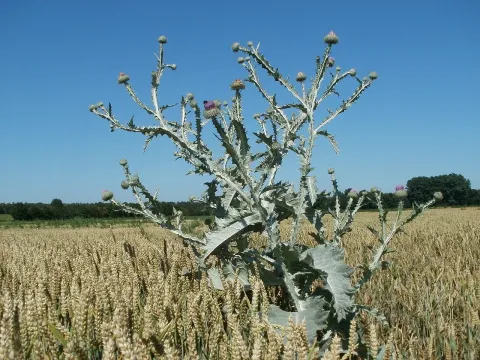
Onopordum floccosum
Onopordum floccosum
Onopordum floccosum belongs to the Asteraceae family and is typically cultivated as a biennial crop, requiring careful timing for successful establishment.
What the section contains
Onopordum floccosum
Seeds should be sown in early spring into well-tilled soil, allowing them to germinate and develop a robust rosette before the heat of summer.
A sowing depth of 1.5 to 2 centimeters is optimal to ensure sufficient soil-to-seed contact and moisture availability for uniform germination.
Row spacing should be maintained between 60 and 70 centimeters to provide enough light and air circulation for each individual plant.
Proper field preparation, including the removal of perennial weeds, is essential for the crop to flourish during its first year of growth.
This crop is highly drought-tolerant and thrives in full sun, making it an excellent choice for open fields that receive significant solar radiation.
Fertile, well-draining soils with a neutral to slightly alkaline pH are ideal, while heavy or waterlogged soils should be strictly avoided.
Regular cultivation between rows is necessary to prevent compaction and manage competition from invasive species that may occupy the area.
The plant demonstrates excellent winter hardiness, surviving cold temperatures naturally without the need for additional protective measures.
Given its size, the species requires adequate spacing to prevent self-shading and to allow the roots to access deep moisture reserves.
Onopordum floccosum is highly valued for its nectar production, making it a significant asset for beekeepers looking to extend the late-season flow.
Seed yield is generally high, allowing farmers to produce their own planting material for the following seasons efficiently.
In some agricultural contexts, the foliage is processed as a nutritional supplement for livestock, provided it is properly chopped to handle spines.
The fatty oils extracted from the seeds offer potential for industrial application, increasing the crop's overall economic feasibility.
Peak biomass and reproductive output are reached in the second year, coinciding with the plant's final life stage as a biennial.
Weevils and aphids are common pests that target the foliage and developing buds, which can negatively impact the plant's overall health and vigor.
Powdery mildew represents the primary fungal threat, particularly in humid or stagnant air conditions that encourage spore germination.
Root rots caused by excess soil moisture can lead to rapid plant decline, reinforcing the need for well-drained planting sites.
Proper crop rotation and spatial isolation from other Asteraceae species significantly reduce the risk of pest and disease outbreaks.
Integrated management practices help maintain yield quality without the necessity for excessive chemical intervention in the field.
Harvesting should occur when the flower heads have fully matured and begun to dry, indicated by a deep brown coloration of the seed coat.
For large-scale operations, mechanical harvesting is feasible, provided the timing is precise to prevent the seeds from scattering naturally.
After harvesting, the material must be dried in a ventilated area to ensure moisture levels remain low, preventing degradation or mold growth.
Threshing and cleaning procedures are necessary to remove debris, ensuring a high-quality product for storage or further processing.
Stored seeds remain viable for several years if kept in a cool, dry, and dark environment, protected from moisture and pests.