
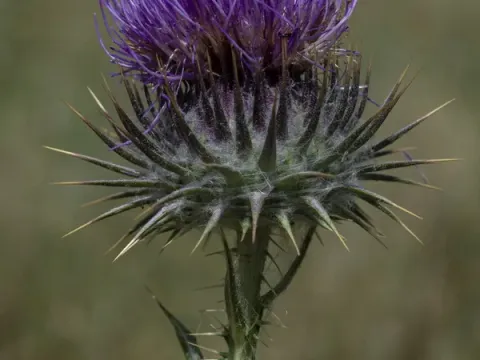
Onopordum corymbosum
Onopordum corymbosum
Onopordum corymbosum, a member of the Asteraceae family, is a robust plant that requires specific preparation for successful establishment. Sowing typically takes place in early spring once soil temperatures reach at least 8–10°C.
What the section contains
Onopordum corymbosum
The seeds should be sown at a depth of 2–3 centimeters to ensure optimal moisture retention. Adequate seed-to-soil contact is critical for high germination rates, especially in drier soil conditions characteristic of early spring.
For uniform stand density, precision seeders are recommended. The sowing density should be adjusted based on the intended use, whether for honey production, ornamental purposes, or biomass accumulation.
Early sowing is beneficial as it allows the plant to develop a strong root system before the onset of peak summer heat. This deep root development is a defining characteristic of its resilience in various agricultural landscapes.
Once established, the plant shows strong vigor. Monitoring the seedlings during the first month is essential to ensure that weed competition does not stunt early growth phases.
This crop thrives in well-drained, fertile soils ranging from sandy loams to silty clays. It is highly sensitive to waterlogging, which can cause root rot and significantly reduce stand density and overall health.
Onopordum corymbosum is highly drought-tolerant and performs best in full sunlight. Optimal growth is observed in open field conditions where the plants have sufficient space to reach their full architectural potential.
The ideal soil pH is neutral or slightly alkaline (6.5 to 7.5). Soil testing prior to sowing is advised to adjust nutrient levels, particularly ensuring sufficient potassium levels which support stem strength and flowering.
While the plant is hardy, it benefits from balanced fertilization during the active growing season. Nitrogen should be applied judiciously to encourage leaf development without creating excessively soft tissue that is susceptible to lodging.
Maintaining proper soil aeration is necessary. Mechanical cultivation between rows is beneficial, provided it is shallow enough to avoid damaging the primary taproot that anchors the plant.
Disease management is centered around preventing fungal infections, particularly powdery mildew, which can occur during periods of high humidity and poor ventilation within the crop canopy.
Pests such as aphids and specialized weevils are the primary threats. Aphids weaken the plant by feeding on sap, while weevils target the seed heads, which can be devastating if the crop is grown for seed production.
Integrated Pest Management (IPM) techniques are highly recommended. This includes encouraging natural predators, monitoring threshold levels for intervention, and using selective treatments only when absolutely necessary.
Crop rotation is a vital tool for controlling soil-borne pathogens. Avoiding fields where sunflower or other Asteraceae crops were recently grown helps minimize the buildup of host-specific diseases.
Regular field scouting is the most effective way to address problems early. Early detection of larval activity or leaf discoloration allows for targeted interventions that are more sustainable and cost-effective.