
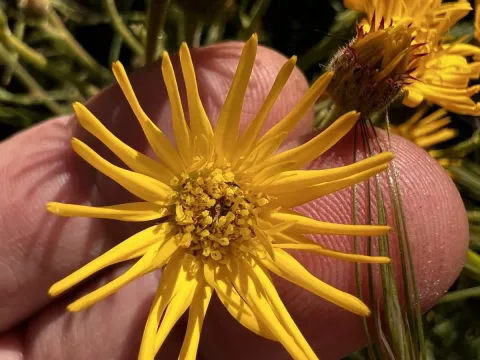
Heterotheca grandiflora
Heterotheca grandiflora
Heterotheca grandiflora, commonly known as the telegraph plant, typically follows an annual or biennial growth cycle in agricultural settings.
What the section contains
Heterotheca grandiflora
Seed germination is highly efficient, often occurring during the cool transitions of autumn or spring when moisture levels are sufficient.
For uniform crop establishment, seeds should be surface-sown or covered with a very thin layer of soil to ensure proper light exposure.
Optimal sowing density is crucial to prevent resource competition and ensure individual plants reach their full vegetative potential.
Field preparation must prioritize a clean seedbed to minimize early competition from invasive weed species that may share similar environmental niches.
As a member of the Asteraceae family, this species is well-adapted to arid and semi-arid climates, demonstrating significant drought tolerance.
The plant thrives in full sun exposure and requires sites with excellent drainage to prevent the development of root-related pathogens.
It displays remarkable flexibility regarding soil chemistry, growing successfully in sandy, loamy, or even disturbed, nutrient-poor substrates.
Irrigation management is minimal, as the crop is designed to utilize available rainfall efficiently once the root system is established.
Climate adaptability includes the ability to withstand high heat, making it a viable candidate for cultivation in regions with long, intense summers.
The primary threats to crop health include fungal diseases such as powdery mildew, which thrive in humid or stagnant air environments.
Root rot remains a concern if the crop is planted in heavy, waterlogged soils, necessitating proper site selection before sowing.
Insect pests such as aphids and specialized coleopterans can impact the quality of both the foliage and the flower buds during development.
Monitoring for signs of stress is essential, as early detection allows for targeted, low-impact interventions rather than broad-spectrum chemical usage.
Implementing proper spacing and crop rotation strategies is the most effective defense against the buildup of species-specific pathogens.
Timing the harvest is critical, as it depends on whether the objective is biomass production or seed harvesting for subsequent cycles.
For biomass, the optimal window for mowing is during the early flowering stage to ensure the highest concentration of phytochemicals.
Seed collection must be managed carefully, as the seeds are equipped with pappus structures that facilitate rapid dispersal via wind gusts.
Utilizing specialized machinery with adjustable airflow is necessary to recover seeds efficiently without significant losses in the field.
Post-harvest processing requires immediate drying in a controlled environment to ensure the stability of the crop and prevent spoilage.