
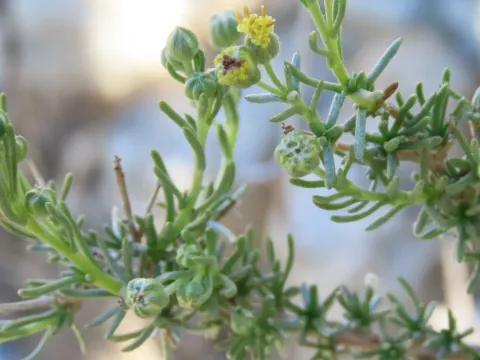
Eriocephalus microphyllus
Eriocephalus microphyllus
Propagation of Eriocephalus microphyllus in a commercial agricultural setting is primarily achieved through seed sowing or vegetative cuttings from selected mother plants.
What the section contains
Eriocephalus microphyllus
Seeds should be sown in a well-draining, sandy-based medium, maintaining consistent but not excessive moisture to support germination within several weeks.
Stem cuttings are often preferred for uniformity; these are taken from semi-hardwood shoots and treated with rooting hormones before being placed in a greenhouse environment.
Optimizing the temperature between 18 and 22 degrees Celsius is essential for both seed germination and the successful development of root systems in cuttings.
Young plants should be hardened off before being transplanted into the permanent field site, ensuring they are protected from extreme weather shifts during their initial establishment.
Belonging to the Asteraceae family, Eriocephalus microphyllus originates from arid regions of South Africa, adapting it perfectly to dry, resource-limited environments.
This crop requires full sun exposure and thrives in sandy, nutrient-poor, and highly porous soils where water cannot accumulate near the root zone.
Environmental conditions should mimic its natural habitat, emphasizing low relative humidity and good air circulation to prevent the development of opportunistic fungal pathogens.
Fertilization should be kept to a minimum, as high nitrogen levels often result in soft, succulent growth that is more susceptible to environmental stress and pests.
Watering management is crucial; although drought-tolerant, young plantations require consistent moisture to establish, while mature plants should be allowed to dry out significantly between irrigations.
The primary economic value of this crop is its potential for essential oil production, which is extracted via steam distillation from the flowering aerial parts.
Planting densities are typically calibrated to balance competition and yield, with standard commercial layouts utilizing 10,000 to 12,000 plants per hectare.
Biomass production depends heavily on the age of the plantation and local precipitation patterns, with established fields producing 3–5 tonnes of dried matter per hectare.
Peak oil yield is achieved when plants are in the late budding to early flowering stage, as this is when the concentration of volatile compounds is at its highest.
After five years of production, yield usually declines, necessitating a pruning regime or field rotation to maintain the high quality of the essential oil extract.
Fungal issues, particularly root rot and wilting, represent the most significant threat to Eriocephalus microphyllus, usually caused by improper irrigation practices in heavy soils.
Pests such as spider mites and mealybugs can infest crops during periods of stagnant, humid air, which often occur in greenhouse or high-density field conditions.
Powdery mildew can appear on the foliage if air movement is insufficient, potentially damaging the surface area required for photosynthesis and reducing overall plant vigor.
Integrated pest management strategies focusing on cultural practices, such as proper spacing and cleaning of tools, are highly effective in minimizing chemical input requirements.
- Regular monitoring of soil moisture to prevent waterlogging.
- Pruning to maintain open canopy structure for improved aeration.
- Isolation of infected specimens to prevent rapid spread across the plantation.
Harvesting is best conducted during the early morning hours, as this timing ensures that the volatile aromatic compounds are at their peak concentration before midday heat.
Mechanical harvesting equipment is generally used to shear the upper portion of the plants, which are subsequently collected for immediate transport to processing facilities.
Speed of processing is vital for this crop, as harvested material left in piles can rapidly self-heat, leading to the degradation of high-quality aromatic constituents.
Drying of the raw material should be done in covered, well-ventilated structures away from direct sunlight to preserve the integrity of the essential oil profile.
Post-harvest management involves a rest period for the plants, during which light supplemental irrigation may be applied if conditions are excessively dry to encourage recovery.