
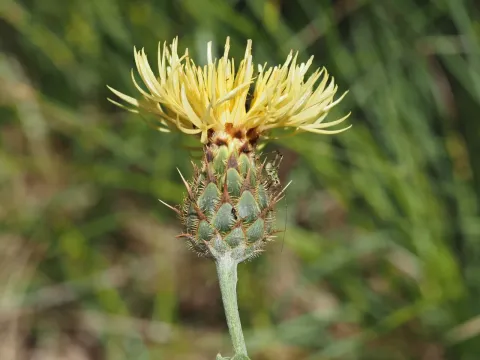
Hill cornflower
Centaurea collina
Hill cornflower (Centaurea collina) is a perennial herbaceous plant belonging to the Asteraceae family. It is native to the dry, stony slopes and grasslands of Southern and Eastern Europe, showing remarkable adaptation to harsh environmental conditions.
What the section contains
Hill cornflower
The plant thrives in well-drained, sandy, or calcareous soils. It is highly valued for its ability to grow on marginal lands where more demanding crops would fail, making it a sustainable choice for certain agricultural landscapes.
As a light-loving species, it requires full sun exposure to reach its full development potential. Its drought resistance is facilitated by a deep taproot system, which allows it to access water reserves unavailable to shallow-rooted plants.
Agricultural practices for this crop are relatively simple. It requires minimal irrigation and is generally resistant to cold stress, making it an excellent candidate for regions with unpredictable climatic conditions.
The primary economic use of Centaurea collina is as a medicinal plant. It serves as a source of raw material for pharmaceutical extracts, known for their anti-inflammatory and antiseptic properties in traditional herbal medicine.
Despite its robustness, the plant can be susceptible to fungal infections such as powdery mildew, particularly when grown in environments with poor air circulation or excessive moisture levels.
Aphids are the most common pests affecting this species. They typically cluster around the flower buds and young stems, potentially reducing the quality and yield of the harvested biomass.
Effective pest management relies on maintaining proper plant spacing, which ensures adequate airflow and reduces the probability of moisture-related disease outbreaks.
Farmers are advised to use organic pest control methods whenever possible to maintain the purity of the harvested medicinal material for end-use processing.
Field monitoring during the budding season is critical to ensure that insect damage does not reach economic thresholds, thereby securing the quality of the final product.