
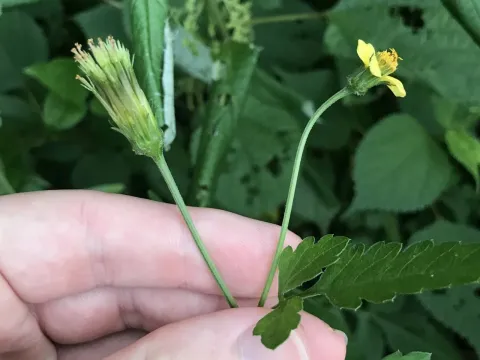
Hairy beggarticks
Bidens biternata
Hairy beggarticks (Bidens biternata) is a member of the Asteraceae family. It is an annual herbaceous plant widely recognized for its opportunistic growth habit in disturbed habitats and moist agricultural environments.
What the section contains
Hairy beggarticks
The species thrives in soils with high moisture content and is particularly well-adapted to tropical and subtropical climates, often appearing as a persistent weed in irrigated croplands.
It requires abundant sunlight and nutrient-rich soil to achieve its full potential height. The plant exhibits rapid growth phases, allowing it to complete its life cycle quickly in favorable conditions.
Botanically, Bidens biternata is identified by its compound leaves and small, yellow flower heads which eventually develop into prickly achenes designed for dispersal via attachment to animals.
While often managed as a weed, the plant has historical significance in traditional medicine, where its extracts are utilized for their potential anti-inflammatory and antiseptic properties.
The plant is susceptible to common fungal pathogens affecting the Asteraceae family, particularly powdery mildew, which can thrive in stagnant air conditions within dense weed clusters.
Insect pests such as aphids and leaf miners are frequent threats to the plant, targeting the tender leaves and stems and potentially reducing the photosynthetic area.
Effective management requires a combination of pre-emergent and post-emergent herbicides to interrupt the rapid colonization process of this vigorous weed species.
Mechanical control techniques, including harrowing and shallow tilling, are effective only if performed before the plant reaches the seeding stage to prevent soil seed bank accumulation.
Agricultural monitoring is critical because the seeds possess strong hooks, facilitating long-distance transport through machinery and human activity, necessitating strict sanitation protocols.