
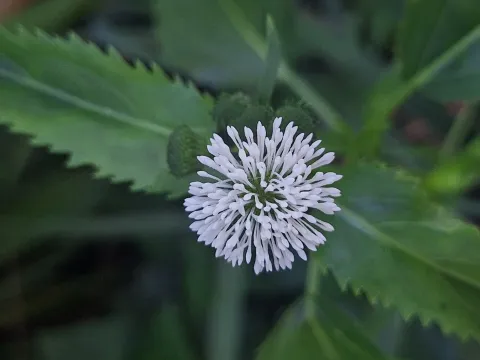
Gymnocoronis
Gymnocoronis
Gymnocoronis (Gymnocoronis spilanthoides), commonly known as water snowflake or Senegal tea plant, is a perennial aquatic herbaceous plant belonging to the Asteraceae family. While it is sometimes cultivated for ornamental purposes in controlled settings, it is globally recognized as a persistent invasive weed.
What the section contains

Gymnocoronis
The plant originates from tropical South America, specifically regions in Argentina, Brazil, and Paraguay. It thrives in wetlands, marshes, and along the edges of slow-moving streams or ponds, where it can easily establish itself in nutrient-rich, saturated substrates.
Botanically, the plant is characterized by hollow, succulent stems that can grow quite long, enabling the plant to float or crawl over water surfaces. Its leaves are opposite, serrated, and lance-shaped, contributing to the plant's aggressive growth rate in favorable warm climates.
Gymnocoronis requires high moisture availability and relatively warm temperatures for optimal development. It is highly adaptable to water depth, being able to survive in both fully submerged conditions and partially inundated mudflats, which makes its environmental niche quite broad.
In terms of agricultural use, it is generally discouraged due to its potential to become a noxious weed. In some limited contexts, it has been explored for phytoremediation purposes in managed systems, but its high propensity for uncontrolled spread makes it a liability in most agricultural regions.
The primary threat posed by Gymnocoronis is its extreme invasiveness and ability to outcompete native aquatic flora. Its vegetative reproductive capacity is so potent that even small fragments of stems can establish roots, facilitating rapid spread across water systems.
This plant poses significant challenges to water management and irrigation infrastructure. By forming dense, interwoven mats of vegetation, it slows down water flow, increases sedimentation, and disrupts aquatic ecosystems by reducing light penetration and oxygen levels.
There are no major pests or diseases that successfully suppress Gymnocoronis outside its native range. Because it is so resilient, traditional mechanical control often fails, as the plant fragments easily and re-colonizes areas downstream, exacerbating the problem.
Chemical control is often the only viable option in severe infestations. However, it requires careful selection of herbicides that are aquatic-safe and specific to broad-leaved invasive species, ensuring minimal impact on non-target riparian vegetation.
Integrated pest management strategies focusing on physical removal combined with habitat modification are currently the recommended practice. Sustained monitoring and eradication efforts are necessary to prevent the plant from establishing in sensitive local waterways.