
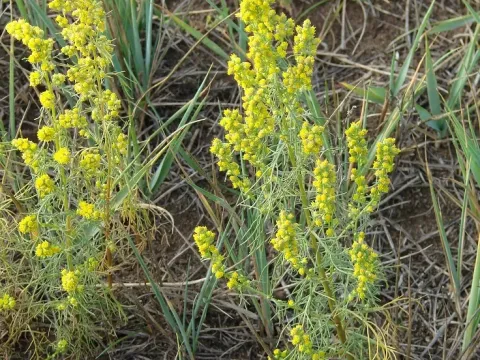
Bog wormwood
Artemisia palustris
Bog wormwood is propagated primarily through seeds, which should be sown in early spring once the soil temperature consistently reaches 8–10 degrees Celsius.
What the section contains
Bog wormwood
For commercial cultivation, winter sowing is also an option, allowing seeds to undergo natural stratification. This process often results in more uniform germination and stronger root development during the spring season.
Seed depth should be minimal, ideally between 0.5 and 1 centimeter. Because the seeds are small, it is essential to ensure they have good contact with moist, fine-tilled soil to facilitate effective germination.
If starting with transplants, seeds are sown in greenhouses during March. The seedlings are moved to the field once the threat of frost has passed, ensuring stable growth conditions.
Plant spacing should be adjusted to allow for mechanical weeding and proper air circulation; rows are typically spaced 45–60 centimeters apart to maximize yield and plant health.
Bog wormwood belongs to the Asteraceae family. As a perennial herbaceous plant, it is naturally adapted to moist environments, which defines its specific agricultural requirements compared to other wormwood species.
Unlike many arid-land wormwoods, this variety requires consistent moisture. It does not tolerate prolonged drought well, making field selection near groundwater or areas with reliable irrigation systems highly beneficial.
The ideal soil for this crop is light, well-aerated sandy loam or fertile loam with a neutral to slightly acidic pH. Avoiding compacted soil is crucial for the health of the plant's root system.
The plant is highly photophilous and requires full sun exposure to flourish. High levels of solar radiation are essential for the synthesis of secondary metabolites and essential oils within the foliage.
This species is very cold-hardy, capable of surviving harsh winters in temperate climates without needing special winter protection, provided there is a stable layer of snow cover.
The yield of Bog wormwood is primarily measured by the mass of dry aerial parts. Peak productivity is typically observed from the second to the third year after establishment.
Harvesting the crop at the onset of flowering is critical, as this is when the concentration of essential active compounds is at its peak. Timing is everything for producing high-quality medicinal raw material.
With proper fertilization and management, especially nitrogen-based support during the spring, the plantation can maintain stable yields for several consecutive growing seasons.
After each harvest, the plant is capable of regenerating, provided the field is managed correctly. This allows for a multi-year exploitation of a single plantation before productivity naturally begins to decline.
Economic output is heavily dependent on the efficiency of the harvesting process and the speed at which the harvested material is processed into a dried, stable state.
While Bog wormwood is generally robust, it is susceptible to fungal infections when grown in excessively wet conditions, which can lead to root or stem rot.
Common pests like aphids and certain spider mites can damage young growth. Integrated pest management strategies using biological controls are recommended to preserve the organic quality of the medicinal harvest.
Weeds are the primary competitor during the early development stages. Frequent inter-row cultivation is necessary to prevent weeds from outcompeting the crop for water and sunlight.
Crop rotation is essential to prevent the buildup of soil-borne pathogens. Avoid planting Bog wormwood after other members of the Asteraceae family to reduce the risk of shared diseases.
Regular field scouting is vital to detect early signs of stress or infestation, allowing for targeted intervention before the health of the entire plantation is compromised.
Harvesting is performed mechanically during the early flowering phase. It is essential to cut the plants before they reach full seed maturation to maximize the quality of the volatile oil content.
Specialized mowers are used to crop the foliage at an appropriate height, ensuring that coarse, woody stem bases are left behind and only high-quality leaf and flower material is collected.
Harvested material must be transported to the drying facility immediately. Drying should be carried out at temperatures not exceeding 40–45 degrees Celsius to preserve the plant's medicinal properties.
Once dried, the raw material should be cleaned of impurities and packaged in moisture-proof, light-protected containers to ensure long-term stability and freshness.
Final storage should take place in a climate-controlled warehouse to prevent moisture accumulation and the loss of aromatic qualities that define the product's market value.