
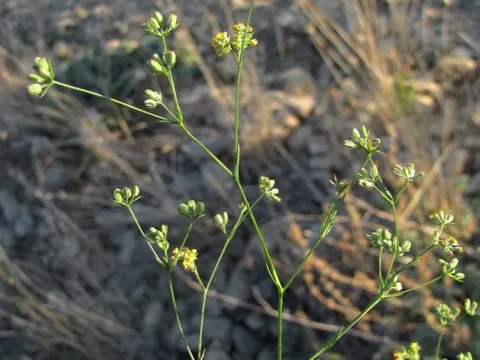
Bupleurum brachiatum
Bupleurum brachiatum
Bupleurum brachiatum is a perennial herbaceous plant belonging to the Apiaceae family. It is natively distributed across mountainous terrains and arid steppe regions, where it has evolved to thrive in rocky soils and challenging climatic environments.
What the section contains
Bupleurum brachiatum
The plant requires well-drained, sandy-loam soils to prevent root rot, which is a common issue for this species in cultivation. It thrives in open, sunny locations with good air circulation, which helps maintain the health of the plants and prevents the accumulation of excessive moisture.
Climatic requirements involve a continental regime with warm summers and cold winters. The plant is highly drought-tolerant once established, but providing consistent moisture during the early growth stages is essential for obtaining a higher yield of the medicinal biomass.
Agronomic management includes systematic weed control, as Bupleurum is not highly competitive during its establishment phase. Row spacing should be optimized to allow for mechanical cultivation, ensuring the soil surface remains loose and aerated to facilitate healthy root development.
Economically, this species is highly valued in the pharmaceutical industry due to its chemical composition, which includes triterpenoid saponins and flavonoids. These compounds serve as active ingredients in various medicinal formulations aimed at supporting liver function and bile production.
The main pathological threats include fungal infections such as powdery mildew and various leaf spots, which often manifest in high-humidity conditions. Proactive management involves ensuring adequate plant spacing and applying preventative fungicides according to local agricultural regulations.
Insect pests, including aphids and mites, can occasionally affect the foliage, resulting in reduced photosynthetic efficiency. Effective control strategies involve monitoring the pest population levels and utilizing integrated pest management tactics to minimize the need for chemical intervention.