
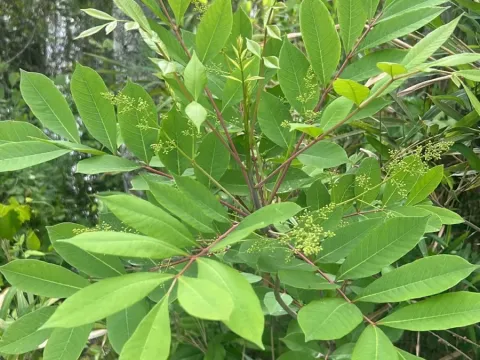
Japanese lacquer tree
Toxicodendron vernix
Propagation of this culture in agricultural conditions is most often carried out by seeds or root cuttings. Seeds require mandatory pre-stratification to overcome dormancy, which typically takes two to four months at low temperatures.
What the section contains
Japanese lacquer tree
The optimal time for sowing seeds in nurseries is early spring, after the risk of frost has passed. Seeds should be planted at a depth of 2–3 centimeters in loose, nutrient-rich, well-drained substrate.
For vegetative propagation, root segments are planted in prepared trenches during the autumn, allowing the saplings to root before the start of the active vegetation period.
An important factor during cultivation is maintaining adequate spacing between rows, typically at least 3–4 meters, to ensure sufficient sunlight and provide access for tapping operations.
Care for young seedlings requires regular weeding within the root zone, as the culture is sensitive to competition for nutrients in the early stages of development.
The Japanese lacquer tree belongs to the Anacardiaceae family and prefers moist, well-drained soils with a neutral or slightly acidic pH. The culture thrives most effectively in loams rich in organic matter.
Normal growth requires a climate with moderate temperatures and sufficient rainfall during the growing season. The plant shows sensitivity to extreme droughts and requires additional irrigation in its early years.
The tree prefers sunny or semi-shaded areas protected from strong winds, which can damage brittle branches and hinder the lacquer harvesting process.
Special attention should be paid to soil preparation before planting: deep tillage and the addition of compost promote the development of a strong root system necessary for the tree's longevity.
In regions with harsh winters, young trees need to be protected, as sudden temperature fluctuations and frozen ground can cause damage to the bark and plant tissue.
The main product of this culture is lacquer sap, known as urushi, which is secreted when the tree bark is damaged. Yield depends on the tree's age and environmental conditions.
Industrial exploitation of trees begins when they reach 8–10 years of age, once the trunk has achieved a sufficient diameter to perform tapping.
From one adult tree during the tapping season, only a limited amount of raw lacquer is collected, which explains the high market price of the final product.
Tapping intensity is regulated by professionals to prevent exhausting the tree and to allow it to recover between incision cycles.
The quality of the raw material is highly dependent on the season of collection and the specific weather conditions of the year, which are critical for high-quality varnish production.
The culture is susceptible to certain fungal diseases that develop in conditions of excessive humidity and poor air circulation within the plantation.
Among pests, leaf-eating insects pose the greatest danger, as they can cause significant damage to the tree's photosynthetic surface if their population grows unchecked.
Disease prevention includes timely sanitary pruning of the crown to improve aeration and removing infected branches to stop the spread of pathogens.
An important protection aspect is monitoring bark condition, as any mechanical injury or crack serves as an entry point for microorganisms.
The use of protective agents is only allowed in accordance with strict regulations, considering the presence of allergenic components within the sap.
The harvesting process involves professional tapping, which must be performed in dry weather, as moisture is critical to the quality of the sap.
A specialist makes a series of precise incisions on the trunk using specific tools to stimulate latex secretion, which is then carefully collected into containers.
The collection period is typically restricted to summer months, when the tree's metabolic processes are most active and sap viscosity is optimal for harvesting.
The collected material undergoes thorough cleaning to remove bark fragments, wood chips, and other impurities before being prepared for transport.
Lacquer collection is a labor-intensive process requiring high professional skill and strict adherence to safety measures due to the toxicity of the raw sap.