
Hybrid pistachio
Pistacia hybrids
Description
Sowing dates
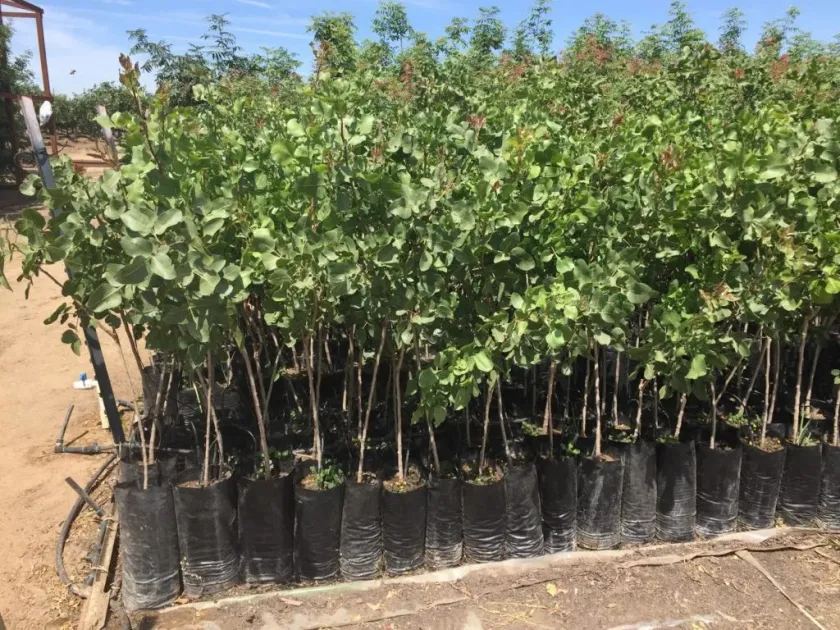
The planting of hybrid pistachio is typically carried out using nursery saplings, obtained through clonal propagation or grafting onto rootstocks that are resistant to local soil conditions. Planting in open ground is performed in early spring once the soil warms up to 10–12°C, or in autumn in regions with mild climates.
When establishing commercial orchards, it is important to consider the planting scheme, which for hybrids is often 6 by 7 meters. This provides sufficient feeding area for the development of the root system and canopy, and also allows for the mechanization of inter-row maintenance.
An essential aspect is ensuring cross-pollination, as the pistachio is a dioecious plant. In orchards, it is necessary to place male pollinator trees in a ratio of approximately 1 to 8 or 1 to 10 relative to female trees, oriented according to the direction of prevailing winds.
Hybrid forms often demonstrate higher growth energy in the first years of life compared to wild species, which requires careful control of the state of the tree circles. Young saplings need regular irrigation until full establishment, which usually occurs after 1–2 years.
The use of containerized saplings with a closed root system significantly increases the survival rate of hybrids during spring planting. This allows the crop to better adapt to environmental stressors during the period of active vegetation.
Growing requirements
The hybrid pistachio belongs to the Anacardiaceae family and is valued for its high drought tolerance. It is ideally suited for regions with hot and dry summers, where rainfall is limited and the evaporation rate is high.
The crop prefers well-drained, deep sandy-loam or light loamy soils with a neutral or slightly alkaline reaction. Stagnant moisture in the root zone is detrimental to the plant, so selecting a site with a low water table is critical.
The plant requires a high amount of sunlight and heat for proper fruit ripening. The temperature regime during the growing season must be consistently high; meanwhile, hybrids often show better resistance to late frosts than many wild pistachio varieties.
Agronomic practices include moderate application of nitrogen fertilizers in the first years to stimulate vegetative growth and the application of potassium-phosphorus compounds during the tree's transition to the active fruiting stage.
The organization of drip irrigation can significantly increase the productivity of hybrid pistachios. Despite a high tolerance to water deficiency, additional irrigation during critical fruit development phases increases their market weight and the percentage of shell opening.
Yield
Hybrid pistachios enter commercial fruiting faster than wild seedlings — usually at 5–7 years after planting. A full harvest begins when the tree reaches 10–12 years of age, showing high stability.
Yield depends on the tree's age, the varietal characteristics of the hybrid, and the level of agronomic care. A healthy mature tree, with proper maintenance, can produce from 10 to 20 kilograms of dried nuts per season.
Pistachio fruiting is characterized by periodicity; however, modern hybrids are selected by breeders to minimize this effect. Proper nutrition and timely irrigation help the tree accumulate sufficient nutrients for a regular harvest.
Nut quality is determined by kernel fullness and the percentage of shell opening. In hybrids, this indicator is often higher than in parent forms, making them more attractive for the food industry.
To assess plantation productivity, agronomists use the indicator of marketable product output per hectare. Under intensive cultivation technology using drip irrigation, yield reaches high levels, ensuring a return on investment.
Main diseases and pests
The primary diseases of the pistachio are fungal infections, such as gray mold and alternaria, which occur when humidity regimes are disrupted. Prevention consists of maintaining air circulation in the canopy through proper pruning.
Pests, including the pistachio psyllid and various types of weevils, can cause significant damage to the crop. Regular monitoring of the trees allows for the timely application of biological or chemical protection measures.
Special attention should be paid to protection against root rots, which develop under waterlogging or poor soil aeration. Adhering to irrigation rules and ensuring good drainage are the main methods for preventing these diseases.
In regions with high rodent populations, it is necessary to protect the trunks of young trees with special nets. Bark damage can lead to weakening of the plant and infection by pathogenic microorganisms.
An integrated pest management system includes the use of pheromone traps to control harmful insect populations. This allows for minimizing pesticide use while maintaining the sustainability of the produced crop.
Harvesting
The harvest begins when the fruits acquire their characteristic color and the hull (pericarp) begins to separate easily from the nut. At this time, the moisture content in the kernel decreases to optimal levels.
For large-scale harvesting, specialized mechanized shakers are used. These devices gently affect the trunk or branches of the tree, causing the fruit to fall onto catching systems.
An important requirement is minimizing the time from harvest to primary processing. Hulling must be completed within the first 24 hours to prevent nut spoilage and shell darkening.
After hulling, the nuts are subjected to drying in warm air flows. This reduces moisture to 5–7%, which is necessary for long-term storage without losing taste or risking the development of mold fungi.
Finished product storage is carried out in dry, cool facilities with good ventilation. Properly prepared pistachios can retain their organoleptic properties for 12 months or longer.