
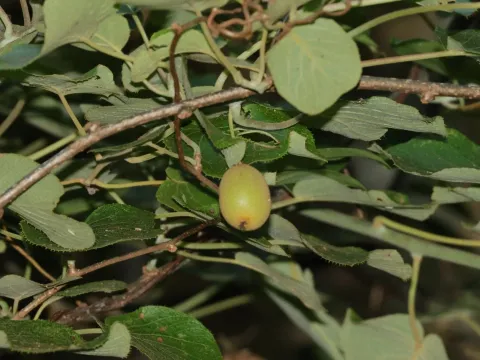
Actinidia
Actinidia Lindl.
Actinidia is a perennial woody vine belonging to the Actinidiaceae family. In both commercial and amateur orchards, the crop is primarily propagated vegetatively through hardwood or softwood cuttings and layering, which ensures the preservation of the mother plant's specific varietal traits.
What the section contains
 Actinidia chinensis
 Planch. x Actinidia deliciosa (A. Chev.) C. F. Liang & A. R. Ferguson
Actinidia chinensis
Actinidia chinensis Planch. x Actinidia deliciosa (A. Chev.) C. F. Liang & A. R. Ferguson
 Actinidia chinensis
 Planch.
Actinidia deliciosa
Actinidia deliciosa (A. Chev.) C. F. Liang & A. R. Ferguson
Actinidia deliciosa
Actinidia deliciosa (A. Chev.) C. F. Liang & A. R. Ferguson x A. valvata Dunn
Actinidia chinensis
Actinidia chinensis Planch.
Actinidia deliciosa
Actinidia deliciosa (A. Chev.) C. F. Liang & A. R. Ferguson
Actinidia deliciosa
Actinidia deliciosa (A. Chev.) C. F. Liang & A. R. Ferguson x A. valvata Dunn
 Actinidia giraldii
 Diels.
Actinidia giraldii
Actinidia giraldii Diels.
 Actinidia hemsleyana
 Dunn
Actinidia hemsleyana
Actinidia hemsleyana Dunn var. hemsleyana
Actinidia hemsleyana
Actinidia hemsleyana Dunn
Actinidia hemsleyana
Actinidia hemsleyana Dunn var. hemsleyana
 Actinidia kolomikta
 Maxim.
Actinidia kolomikta
Actinidia kolomikta Maxim.
 Actinidia valvata
 Dunn
Actinidia valvata
Actinidia valvata Dunn
 Fairchild actinidia
Actinidia x fairchildii Rehder
Fairchild actinidia
Actinidia x fairchildii Rehder
 Hardy kiwi
Actinidia arguta (Siebold & Zucc.) Planch. ex Miq.. x Actinidia chinensis Planch.
Hardy kiwi
Actinidia arguta (Sieb. & Zucc.) Planch.
Hybrid purple actinidia
Actinidia purpurea x Actinidia arguta
Hardy kiwi
Actinidia arguta (Siebold & Zucc.) Planch. ex Miq.. x Actinidia chinensis Planch.
Hardy kiwi
Actinidia arguta (Sieb. & Zucc.) Planch.
Hybrid purple actinidia
Actinidia purpurea x Actinidia arguta
 Hybrids of Actinidia chinensis and Actinidia eriantha
Hybrids between Actinidia chinensis and Actinidia eriantha
Purple kiwi
Actinidia purpurea Rehd.
Hybrids of Actinidia chinensis and Actinidia eriantha
Hybrids between Actinidia chinensis and Actinidia eriantha
Purple kiwi
Actinidia purpurea Rehd.
 Rufus kiwi
Actinidia rufa (Siebold & Zucc.) Planch. ex Miq.
Rufus kiwi
Actinidia rufa (Siebold & Zucc.) Planch. ex Miq.
 Silver vine
Actinidia polygama (Sieb. & Zucc.) Maxim.
Silver vine
Actinidia polygama (Sieb. & Zucc.) Maxim.
 Woolly kiwi
Actinidia eriantha Benth.
Woolly kiwi
Actinidia eriantha Benth.
Actinidia
Planting seedlings into open ground is typically carried out during the spring period, once the threat of late frosts has passed and the soil has sufficiently warmed up. In regions with milder climates, autumn planting is also acceptable, provided it is done 3–4 weeks before the onset of persistent winter frosts.
When using seed propagation, a method reserved mostly for breeding purposes, the seeds require a pre-sowing stratification period of 2–3 months. Sowing is performed in seed trays in late winter or early spring, ensuring a stable humidity level of the growing substrate.
Site selection is critical: Actinidia prefers locations with dappled shade, protected from direct midday sun and strong, drying winds. Because the vines can reach significant lengths, the installation of durable trellises or support systems is essential for successful cultivation.
An important biological feature of this crop is its dioecious nature; most species require both male and female plants to be present in the garden. For a successful harvest, growers must plant these in a ratio of approximately 5:1 to ensure effective cross-pollination by insects.
This crop has high demands regarding soil and air humidity, necessitating regular irrigation, especially during dry spells. The plant does not tolerate waterlogging, so for sites with high water tables, proper drainage systems must be installed to prevent root damage.
Optimal soils for Actinidia are fertile loams or sandy loams with a neutral or slightly acidic pH level. Saline, heavy clay, or excessively alkaline soils are entirely unsuitable for growing these vines, as they lead to chlorosis and stunted growth.
In the first few years after planting, the plant requires mulching around the base with peat, compost, or shredded bark. This practice helps maintain a stable root temperature and prevents soil desiccation, which is vital during hot summer months.
Fertilization should be carried out systematically: nitrogen fertilizers are applied in early spring to stimulate shoot growth, while phosphorus and potassium compounds are provided during the fruit-set phase. Growers must avoid chloride-based fertilizers, as Actinidia is highly sensitive to chlorine.
Winter hardiness varies significantly among species: for example, Actinidia kolomikta is quite cold-resistant and survives harsh winters, whereas large-fruited species like Actinidia deliciosa require careful winter protection or a climate with milder temperatures.
The first harvest from vegetatively propagated vines can be expected 3–4 years after planting, while seedlings take much longer, often 6–8 years to reach maturity. Peak productivity of the vine is generally observed between 10 and 20 years of age.
The yield of a single mature plant depends heavily on compliance with agricultural practices, varietal characteristics, and successful pollination. Under favorable conditions, a strong, healthy vine can produce between 10 and 20 kilograms of fruit per season.
The fruit is a multi-locular berry rich in Vitamin C, organic acids, and essential micronutrients. They possess high biological value and are widely consumed fresh, as well as processed into jams, preserves, juices, and dried snacks.
Annual pruning is necessary to maintain high yields. The primary structural pruning is performed during the dormant season, removing old, damaged, or overcrowded shoots, which improves light penetration and air circulation throughout the vine's canopy.
Actinidia fruits typically do not ripen all at once, requiring harvesting in several stages as they reach technical maturity. The berries are quite delicate, which demands careful handling during the picking and transport processes to prevent bruising.
Actinidia is considered a relatively resilient crop; however, poor agricultural practices can lead to fungal infections such as Phyllosticta leaf spot. Preventive measures include regular sanitary pruning and applications of copper-based fungicides when necessary.
The greatest threat to young seedlings comes from domestic cats, which are irresistibly attracted to the specific essential oils emitted by the vine. They can completely destroy young shoots, so it is recommended to protect new plantings with wire mesh until the plants are at least 3–4 years old.
In conditions of high humidity and poor air circulation, outbreaks of gray mold (Botrytis) can occur, affecting both shoots and ripening fruits. Disease management involves removing infected plant parts and thinning the canopy to improve ventilation.
Pests such as leaf beetles or various weevils may appear occasionally. If pest populations reach economic thresholds, the use of broad-spectrum insecticides is appropriate, strictly adhering to pre-harvest intervals to ensure safety.
Maintaining root health is essential, as excessive moisture combined with soil compaction can lead to root rot. A healthy plant with a strong immune system is far less likely to succumb to pest attacks or persistent fungal pathogens.
Harvesting begins when the fruits acquire their characteristic varietal color and the flesh becomes slightly soft to the touch. Because the berries are prone to dropping quickly once fully ripe, it is not recommended to delay the harvest process.
Fruits are picked manually by carefully detaching them from the stem. For longer storage, it is better to harvest the berries when they are slightly under-ripe, as they will continue to ripen in a cool room without sacrificing flavor or nutritional quality.
The harvested fruit should be sorted by size and maturity. In domestic settings, Actinidia fruits can be stored at temperatures around 0 to 5 degrees Celsius, allowing them to remain fresh for several weeks.
When berries are intended for industrial processing, harvest dates may be shifted to earlier windows. This minimizes losses during transportation and ensures that production facilities receive high-quality raw materials for freezing or canning.
After the harvest is complete, an inspection of the vines is conducted to remove any branches broken during the work. This final step of the annual care cycle prepares the plant for the winter dormancy period and the following season's growth.