
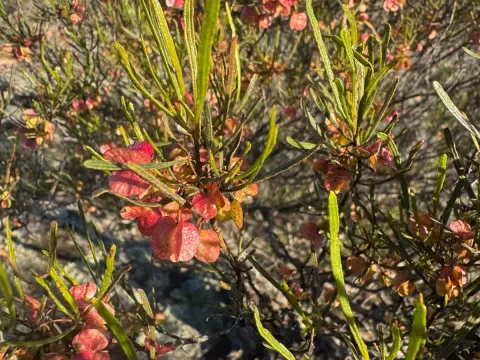
Dodonaea angustissima
Dodonaea angustissima
Propagation of Dodonaea angustissima is best achieved through seeds or semi-hardwood cuttings collected during the active growing season.
What the section contains
Dodonaea angustissima
Seeds require scarification or soaking in warm water to soften the hard outer seed coat, which significantly improves germination rates in nursery conditions.
Cuttings should be placed in a sterile, well-draining medium with bottom heat to encourage rapid root development before transferring to individual pots.
Young plants are sensitive to moisture imbalances; therefore, nursery management must focus on providing consistent yet light irrigation to avoid waterlogging.
Hardening off the seedlings is a crucial step that involves gradually exposing them to outdoor conditions before final planting in the field.
Dodonaea angustissima belongs to the Sapindaceae family and is an evergreen shrub native to the arid and semi-arid landscapes of Australia.
This species is highly adapted to poor soils and requires excellent drainage to thrive, making it an ideal candidate for erosion control in dry climates.
It prefers full sun exposure to maintain its dense foliage and unique narrow-leaf structure, although it can tolerate partial shade in hotter regions.
The plant is known for its remarkable drought tolerance, but it requires deep, infrequent watering during the establishment phase to encourage deep root growth.
Maintenance involves periodic pruning to keep the shrub in shape, as it responds very well to trimming and can be sculpted into windbreaks or privacy hedges.
Root rot is the most significant threat to the plant, usually triggered by excessive irrigation or heavy, poorly drained clay soils that prevent root respiration.
Sap-sucking insects like aphids and scale insects are common pests that colonize tender new growth, causing leaf discoloration and stunted plant development.
Cultural management, such as thinning out dense branches to improve air circulation, is the primary method for preventing fungal outbreaks within the foliage.
Integrated pest management strategies should be employed, prioritizing natural predators or organic sprays before resorting to systemic chemical pesticides.
Regular monitoring of the plant's canopy is essential to catch early symptoms of infestation, ensuring the longevity and health of the shrub in a landscape setting.