
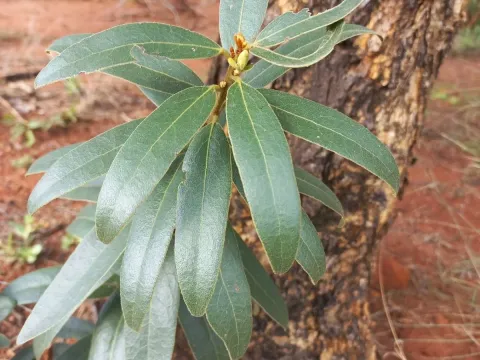
Natal guarri
Euclea natalensis
Natal guarri (Euclea natalensis) is a perennial evergreen shrub or small tree belonging to the Ebenaceae family. It is recognized for its dense, glossy foliage and its ability to thrive in various challenging environments within Southern Africa.
What the section contains
Natal guarri
The plant typically reaches a height of up to 12 meters in ideal conditions. It is naturally adapted to a wide range of habitats, including coastal forests, thickets, and arid rocky slopes, highlighting its extreme environmental versatility.
Regarding cultivation requirements, Euclea natalensis prefers well-drained soil types. While it thrives in full sunlight, it is also capable of tolerating partial shade, making it a flexible choice for various landscaping and reforestation projects.
The species is exceptionally drought-tolerant once established. It does not require high levels of supplemental irrigation, as its root system is highly efficient at extracting moisture from dry or rocky substrates.
Soil management for this crop focuses on preventing waterlogging. While it can tolerate nutrient-poor soils, incorporating light organic matter during the planting phase can significantly improve the growth rate of young specimens.
The fruit of the Natal guarri is a small, spherical berry that turns from green to dark purple or black when ripe. These fruits are edible and possess a characteristic sweet flavor favored by local wildlife and human communities.
Wood utilization is a major aspect of its economic value. The wood is notably dense, hard, and durable, historically being used for crafting walking sticks, handles for agricultural tools, and various small-scale artisan woodworking projects.
In traditional medicinal practices, different parts of the Euclea natalensis plant are used. Studies indicate that extracts from the roots and leaves contain compounds with antimicrobial and anti-inflammatory properties, useful for treating oral infections and various skin ailments.
Ecologically, the tree serves as a vital component in local biodiversity. Its dense canopy provides shelter for birds and small mammals, while its small flowers serve as an important nectar source for pollinators throughout the growing season.
Managing pests and diseases is relatively straightforward, as the plant possesses natural defenses. Regular inspection for common scale insects or leaf-eating caterpillars is recommended, though severe outbreaks are rare under proper environmental conditions.