
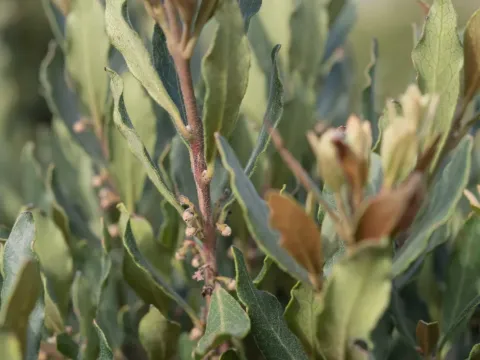
Euclea crispa
Euclea crispa
Euclea crispa, commonly known as the blue-leaved guarri, is an evergreen shrub or small tree belonging to the Ebenaceae family, native to Southern and East Africa.
What the section contains
Euclea crispa
This species is highly valued for its exceptional adaptability to diverse soil types, including rocky terrains and sandy substrates where other crops struggle to survive.
The plant thrives in full sun exposure and is remarkably drought-tolerant, making it an excellent candidate for agricultural projects in arid and semi-arid climates.
Soil requirements for optimal growth involve a well-drained medium; the plant does not tolerate waterlogged conditions which often lead to root rot issues.
While it can withstand light frosts, younger specimens require protection during their initial establishment phase to ensure proper woody stem development.
The fruits of Euclea crispa are small, globose, and edible, providing a nutritious resource for local populations and attracting various bird species to the area.
Its timber is recognized for its high density and strength, often utilized in manufacturing small wooden objects, handles, and providing fuel for cooking.
Euclea crispa serves significant medicinal purposes, with roots and bark traditionally used for various therapeutic applications in regional herbal practices.
As a landscaping and forestry element, the plant is effectively used for erosion control on slopes and as a permanent hedge that provides shelter for biodiversity.
Economic production of this shrub is centered on sustainable wild harvesting and increasing efforts to integrate it into agroforestry systems for better resource management.
Common pests include scale insects that attach to stems and leaves, effectively draining the plant's resources if left untreated for long periods.
Fungal pathogens may emerge in areas with poor airflow or stagnant humidity, necessitating proper spacing during plantation establishment to maintain plant health.
Leaf-eating insects can become a problem during the peak growth season, potentially reducing the photosynthetic capacity of the shrub if infestations are severe.
In nursery settings, seedlings are susceptible to root pathogens if the soil medium is too compacted or holds excessive moisture after irrigation.
Integrated pest management strategies focusing on biological control are recommended to maintain the ecological balance and prevent excessive chemical use.