
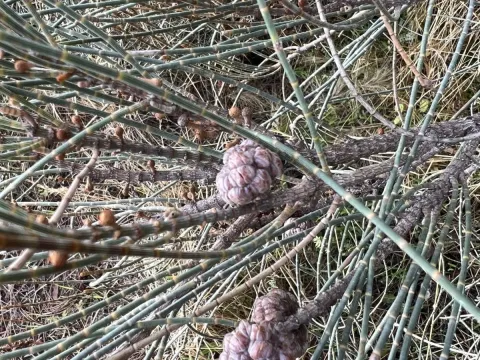
Allocasuarina luehmannii
Allocasuarina luehmannii
Allocasuarina luehmannii, commonly known as Buloke, is an evergreen tree belonging to the Casuarinaceae family. Native to Australia, it is well-adapted to a wide range of climatic conditions, including arid and semi-arid environments.
What the section contains
Allocasuarina luehmannii
This species is highly regarded for its ability to thrive in challenging soil conditions. It displays excellent tolerance to saline and nutrient-poor soils, which makes it an ideal candidate for land rehabilitation projects.
The tree requires full sunlight for optimal growth. While it is naturally drought-resistant once established, young seedlings need a consistent water supply during their initial growth phase to develop a robust root system.
A key biological feature of this species is its symbiotic relationship with nitrogen-fixing bacteria. This adaptation allows the tree to enrich the soil, contributing to the overall health of the surrounding ecosystem.
When establishing a plantation, site selection and weed management are crucial. Providing a clear space around young saplings prevents competition for resources and ensures steady development during the early years.
The primary economic value of Allocasuarina luehmannii lies in its wood, which is known as one of the hardest and densest timbers globally. This high-quality wood is traditionally referred to as 'Buloke'.
Due to its extreme hardness, the timber is highly sought after for specialized applications such as high-end flooring, fine furniture making, and heavy-duty tool handles that require exceptional durability.
Beyond timber production, this species serves as a vital component in agroforestry. It is frequently planted in shelterbelts to protect field crops from strong winds and to stabilize the soil against erosion.
The tree also contributes to groundwater management. Its deep root system helps lower water tables, which is a critical strategy for preventing soil salinization in agricultural landscapes.
While the cycle from planting to harvesting mature timber is lengthy, the long-term yield of high-quality wood and the ecological benefits provided to the farm landscape justify the investment.
Seedlings and young trees are susceptible to grazing by feral animals, particularly rabbits. Implementing physical barriers or fencing is often necessary to protect young plantations during the establishment stage.
Root rot pathogens represent a significant threat to the trees, especially if they are planted in areas with poor drainage. Maintaining good soil structure is essential for disease prevention.
Insect pests, including borers and leaf-eating beetles, can compromise the structural integrity of the wood. Regular monitoring and integrated pest management are recommended to mitigate these issues.
Wildfires pose a constant risk in Australian environments. Developing a strategic wildfire prevention plan, including clearing brush and maintaining firebreaks, is essential for the longevity of the stand.
Overall, maintaining tree health through thinning and density management helps to keep the stands resilient against both pests and environmental stressors, ensuring a higher harvest quality.