
Wullschlaegelia
Wullschlaegelia
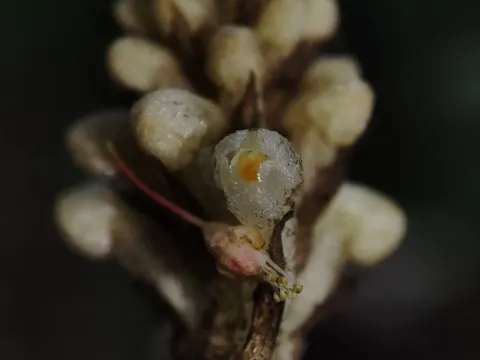
Wullschlaegelia is a genus of myco-heterotrophic plants belonging to the Orchidaceae family. These plants lack chlorophyll and rely entirely on a symbiotic relationship with mycorrhizal fungi to acquire necessary nutrients from the soil.
What the section contains

Wullschlaegelia
The native range of this genus includes the tropical regions of Central and South America, as well as the Caribbean islands. They thrive in damp, forested environments where deep leaf litter provides the necessary conditions for fungal networks.
Botanically, Wullschlaegelia is characterized by reduced, scale-like leaves and small flowers arranged in racemes. Since they do not perform photosynthesis, their physical structure is adapted exclusively for reproductive functions and nutrient absorption via roots.
This plant is not an agricultural crop and has no history of commercial cultivation. Because of its complex dependency on specific fungal partners, it is virtually impossible to grow under conventional garden or greenhouse conditions.
The genus serves as a subject of scientific interest for botanists and ecologists studying the biodiversity of tropical ecosystems. Understanding its life cycle helps researchers assess the health of forest floor microbiomes.
The primary threat to the survival of Wullschlaegelia is habitat destruction caused by deforestation. When forest canopy is removed, the delicate moisture balance of the soil is disrupted, destroying the fungi the plant depends on.
Fragmentation of tropical habitats leads to the isolation of plant populations, reducing genetic diversity. As a specialized organism, it cannot migrate to new territories if its primary symbiotic fungi disappear from the local soil.
Soil pollution from pesticides or fertilizers used in nearby agricultural operations can alter soil chemistry. This disturbance is often lethal for the sensitive fungi, which consequently results in the death of the myco-heterotrophic orchid.
Invasive species that alter the structure of forest litter can outcompete the original ground cover, making it difficult for Wullschlaegelia to establish its root systems. Competition for physical space in the litter layer is a constant ecological pressure.
Climate change, manifesting as prolonged droughts or unpredictable rainfall patterns, poses a severe risk. As the plant requires constant hydration, any disruption in the moisture cycle directly threatens its survival.