
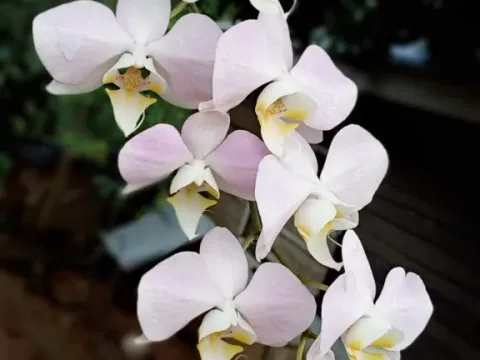
Phalaenopsis
Phalaenopsis Bl.
Phalaenopsis (Phalaenopsis Bl.) belongs to the Orchidaceae family and is recognized as an epiphytic plant. Originating from the tropical regions of Southeast Asia, these plants naturally grow on trees, absorbing moisture and nutrients from the air and rain.
What the section contains


Phalaenopsis
Successful cultivation requires a stable climate with daytime temperatures of +22…+26 °C. A slight drop in temperature during the night is essential to trigger the blooming process, mimicking the natural environmental shifts of their native habitat.
The substrate must be highly breathable, primarily consisting of pine bark, sphagnum moss, and perlite. Unlike conventional potted plants, Phalaenopsis does not tolerate compact soil, which leads to root suffocation and subsequent decay.
These orchids require intense but indirect light. Exposure to harsh, direct sunlight will damage the leaf structure, causing burns and reducing the photosynthetic efficiency of the plant. Using shading screens in greenhouses is common practice.
Watering management is the most critical aspect of the agrotechnology. It should be performed by soaking, allowing the roots to absorb moisture until they turn bright green. Allowing the substrate to dry out between cycles is necessary to prevent fungal infections.
Phalaenopsis orchids are a staple in the commercial floriculture industry, valued for their long-lasting blooms. Modern cultivation relies on high-tech greenhouse facilities where environmental parameters are strictly controlled to maximize growth and floral output.
Mass propagation is achieved via tissue culture (micropropagation), ensuring uniformity in color, shape, and growth rate across the entire batch. Efficient operations focus on optimizing nutrient delivery and photoperiod control to reduce production time.
Plant health is often compromised by fungal diseases, particularly Botrytis and various forms of root rot. Strict hygiene protocols, including the sterilization of tools and the use of sterile substrates, are vital for disease prevention.
Common pests include spider mites, scale insects, and mealybugs, which thrive in low-ventilation areas. Integrated Pest Management (IPM) strategies, including biological controls and targeted applications of systemic pesticides, are employed to protect the crop.