
Orostachys
Orostachys
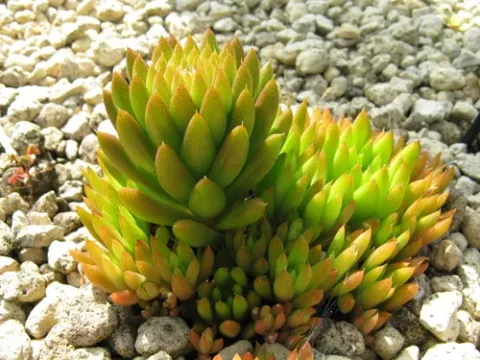
Orostachys is a genus of succulent plants belonging to the Crassulaceae family. These plants are recognized for their monocarpic life cycle and their ability to form dense, rose-like rosettes that thrive in arid, high-altitude environments.
What the section contains


Orostachys
The native range of Orostachys covers vast areas of East Asia, including China, Japan, Mongolia, and the Russian Far East. These plants are typically found growing on rocky crevices, cliffs, and gravelly slopes, indicating their specialized evolutionary niche.
To cultivate Orostachys successfully, growers must ensure maximum sun exposure. These plants are adapted to high-light environments, and any significant lack of light will result in etiolation, rendering the plant structure weak and less resilient.
Soil requirements are strictly based on drainage. The ideal substrate is a gritty, sandy mix that allows water to pass through almost instantly. Organic-rich soils should be avoided as they retain too much moisture and encourage rot.
Regarding agrotechnical practices, Orostachys requires a low-water regime. The plant is drought-tolerant, and over-irrigation is the most common cause of failure in domestic and commercial propagation. Maintenance should focus on preventing weed competition in the early growth phases.
The primary threat to Orostachys is root and crown rot, primarily induced by excess soil moisture or poor drainage. Once internal tissues start to decay, the succulent is difficult to salvage, as the infection spreads rapidly through the fleshy leaves.
Mealybugs are the most persistent insect pests, frequently hiding between the tightly packed leaves of the rosette. Their presence is often identified by the white, cottony substance they produce, which attracts secondary fungal growth.
Aphids can pose a risk during the flowering stage, clustering on the developing inflorescence. While they rarely kill the plant, their feeding can deform the stalks and reduce the success of seed production if the goal is propagation.
In humid or stagnant air conditions, the plants are susceptible to fungal spots. Ensuring that the foliage remains dry after any unavoidable watering is crucial for preventing these infections from compromising the health of the rosettes.
Integrated pest management should be employed, focusing on regular monitoring. Due to the sensitive nature of succulents, chemical pesticides should be tested on a small area first to ensure they do not damage the waxy cuticular layer of the leaves.