
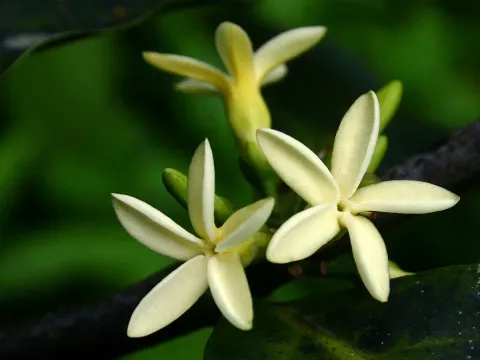
Funtumia
Funtumia
Propagation of Funtumia is typically carried out via seeds or cuttings in specialized nursery environments. Seeds must be sown in prepared substrates immediately after harvesting, as they possess low longevity due to their high oil content.
What the section contains

Funtumia
Germination requires conditions of high humidity and stable temperatures, ideally between 25 and 28 degrees Celsius. Seeds are sown in loose, well-draining soil rich in organic matter to facilitate rapid root system development in young seedlings.
For vegetative propagation, semi-hardwood cuttings are used and planted in shaded areas with consistent irrigation. This method allows for the preservation of varietal traits and accelerates the formation of a productive tree compared to seed-grown specimens.
Transplanting young trees to their permanent plantation location is best performed at the onset of the rainy season, ensuring natural irrigation during the critical adaptation period. Planting density is calculated based on the plantation's end-use goals and soil fertility potential.
Young plants require regular maintenance, including weeding around the base and protection from fast-growing tropical forest flora that can suppress the crop during its early stages of development.
Funtumia, a member of the Apocynaceae family, is a valuable rubber-producing tree native to the tropical forests of West and Central Africa. The plant has high thermal requirements and cannot tolerate even minor frost events.
For successful growth, the crop requires regions with heavy rainfall and high atmospheric humidity, characteristic of equatorial and sub-equatorial zones. Optimal conditions include annual precipitation totals of 1500 mm or more.
Soil requirements include deep, fertile, well-draining loams or alluvial soils. The plant is extremely sensitive to waterlogging, making swampy or poorly drained areas entirely unsuitable for commercial Funtumia plantations.
Light exposure plays a critical role, as Funtumia is a light-demanding species, though it may tolerate partial shade during early growth stages. Placing plantations in open, sunny locations promotes more active latex synthesis within the trunks.
Agricultural practice necessitates the application of organic fertilizers during plantation establishment and rigorous monitoring of soil acidity. Maintaining a neutral to slightly acidic environment is essential for root health and the long-term longevity of the trees.
Funtumia productivity is directly dependent on the intensity of tapping and the age of the tree. The primary economic product is latex, harvested by making precise incisions in the bark, similar to methods used for Hevea brasiliensis.
Average rubber yield per hectare varies based on agricultural management and tree density. Stable raw material collection is possible once trees reach the age of 6 to 8 years, by which time the trunk has achieved the necessary diameter.
The quality of the produced rubber is highly regarded, although Funtumia was historically outcompeted by Hevea due to slower growth rates. Modern breeding efforts aim to enhance latex flow and tree resilience to mechanical damage during harvesting.
Tapping regularity must be carefully balanced to avoid exhausting the tree. Over-tapping leads to reduced plant immunity and increased risk of secondary infections, which negatively impacts the quality of subsequent harvests.
The overall economic viability of the crop is often considered within agroforestry systems, where Funtumia is grown in combination with other tropical perennials, allowing farmers to diversify their income streams.
Among the most significant pests are various insect species that damage the bark and wood. Bark damage at tapping sites creates entry points for fungal pathogens and wood-boring insects.
Fungal diseases causing root and trunk rot occur most frequently when water balance is disrupted or soils are waterlogged. These diseases can lead to mass plantation failure if sanitary measures are not implemented in a timely manner.
Leaf-eating insects can significantly reduce the photosynthetic surface area, slowing biomass accumulation and reducing the volume of synthesized latex. Pest control involves canopy monitoring and the use of biological control methods.
Typical threats to the crop in tropical conditions include:
- Bark beetles and other wood-boring insects.
- Root rots caused by pathogenic fungi of the Phytophthora genus.
- Powdery mildew infections affecting leaves under high humidity.
- Viral infections spread via unsterilized tools during tapping.
Disease prevention is based on adhering to operational hygiene, disinfecting tools, and maintaining overall tree health through a balanced fertilization program and density control.
Harvesting latex requires highly skilled personnel, as the incision technique must be precise to avoid damaging the tree's cambium layer. Shallow, clean cuts ensure the long-term productivity and health of the plant.
The latex collection process is typically performed during early morning hours, when the tree's metabolic activity is at its peak and the flow of sap is most abundant. This maximizes the volume of raw material collected per cycle.
Following collection, latex requires rapid primary processing: coagulation, washing, and pressing into sheets. Failure to adhere to primary processing technology leads to rapid product spoilage due to bacterial and fungal growth in the raw material.
An essential aspect is adhering to rest periods for the trees between tapping cycles. Intensive exploitation without breaks leads to plantation degradation, which is why harvest schedules are meticulously planned by agronomists for every season.
In addition to latex, the timber of Funtumia at the end of the plantation's life cycle can be utilized in the furniture industry, as it possesses sufficient strength and is easy to process and finish.