
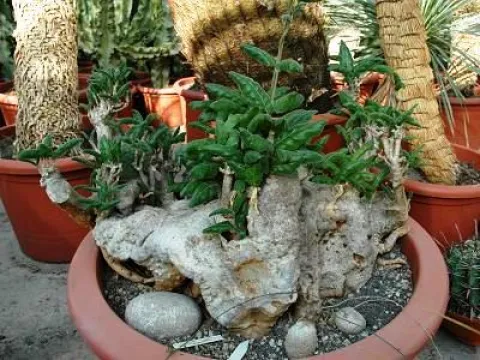
Cibirhiza
Cibirhiza
Cibirhiza is a rare caudiciform succulent and is not cultivated as a traditional agricultural crop. Propagation is primarily performed by seed in controlled greenhouse environments to maintain species purity and ensure the survival of young, delicate seedlings.
What the section contains


Cibirhiza
The sowing process requires a strict temperature range of 22 to 25 degrees Celsius. It is essential to use sterile, highly permeable substrates, such as fine gravel mixed with minimal peat, to prevent damping-off diseases caused by fungal pathogens.
Seeds are known for irregular germination, necessitating stable air humidity levels within the propagation chamber. Early spring is the optimal time for sowing, as it aligns with the natural start of the growth cycle and increasing daylight hours.
Seedling transplanting into individual containers should only occur after the first true leaves have fully developed. The growth rate is characteristically slow, requiring significant care and patience until the caudex begins to form properly.
Root development should be monitored closely during the first months. Application of growth stimulants is generally not recommended unless the seedlings show signs of stunted development, and even then, only in extremely diluted concentrations.
Belonging to the Apocynaceae family, Cibirhiza originates from the rocky landscapes of Africa. In cultivation, it requires conditions that mimic its natural habitat, emphasizing excellent drainage and a mineral-rich, low-organic soil composition.
The plant is highly heliophilic and requires bright, indirect light for many hours a day to prevent etiolation. If light levels are insufficient, the caudex loses its characteristic shape, and the vine-like stems become weak and prone to snapping.
Temperature management is critical throughout the vegetative season, keeping the environment warm and stable. During the winter dormant period, temperatures must be lowered to approximately 15 degrees Celsius to trigger the plant's metabolic slowing.
Watering techniques are specific: the caudex must remain dry, and water should be applied only to the surrounding soil via bottom-watering. Any water accumulation on the plant's body can cause rapid cellular collapse and subsequent decay.
Good ventilation is mandatory to prevent the accumulation of stagnant air, which is the primary driver for pest outbreaks. Implementing a proper airflow system helps maintain the turgor pressure within the plant tissues and prevents overheating.
The most common pests for Cibirhiza in cultivation are spider mites and mealybugs, which thrive in low-humidity conditions. Routine inspections and mechanical cleaning are necessary to prevent these infestations from reaching critical levels.
Fungal diseases like root rot and gray mold (Botrytis) represent the most significant threat to the survival of the plant. These are usually caused by overwatering or the use of substrates with poor aeration, leading to rapid infection.
Viral infections are rare but can be transmitted through non-sterile tools during maintenance. Sanitizing all cutting and transplanting tools between every individual plant is a standard practice to prevent the spread of systemic diseases.
Chemical control must be handled with care due to the latex-containing sap of the Apocynaceae family. Certain pesticides may cause leaf scorch or tissue damage if applied incorrectly or in excessive concentrations under intense light.
Lack of substrate porosity often leads to the development of anaerobic soil zones. This environment is highly conducive to bacterial growth, which can cause the subterranean parts of the caudex to rot before external symptoms appear.