
Cibirhiza albersiana
Cibirhiza albersiana
Description
Growing requirements
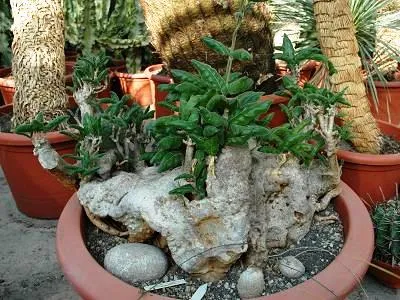
Cibirhiza albersiana is a fascinating succulent species belonging to the Apocynaceae family. It is best known for its significant caudex, a swollen stem base that acts as a water storage organ, an evolutionary adaptation that allows the plant to survive in extreme desert environments.
Native to the arid regions of Somalia in East Africa, this plant is naturally adapted to harsh landscapes with high temperatures and limited precipitation. It thrives in open, rocky habitats where it can access sunlight without competition from taller vegetation.
For cultivation, high light levels are non-negotiable. Cibirhiza albersiana requires intense sunlight to maintain its structural integrity. If the light intensity is too low, the plant will become etiolated, resulting in a weak stem and loss of its natural, compact appearance.
The substrate requirement is strict: the potting medium must be highly porous. A mixture consisting of cactus potting soil combined with at least 50% inorganic material, such as coarse sand, pumice, or perlite, is essential to ensure that water does not linger near the caudex.
Watering techniques are critical for the long-term survival of this species. During the growing season, water only after the soil has completely dried out. During the dormant winter phase, keep the plant almost entirely dry to protect the root system from decay and physiological stress.