
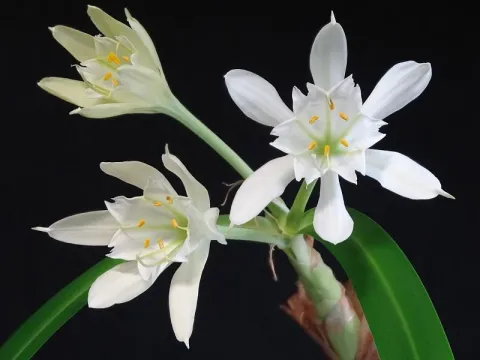
Pamianthe
Pamianthe
Pamianthe is a rare and highly sought-after genus of bulbous plants belonging to the Amaryllidaceae family. Naturally, these plants are native to the tropical rainforests of Peru and Bolivia, where they primarily exist as epiphytes growing in the forks of trees.
What the section contains

Pamianthe
Regarding climatic requirements, Pamianthe thrives in warm, stable conditions with temperatures consistently between 20°C and 25°C. They are highly sensitive to sudden cold snaps and drafts, which can cause significant physiological stress to the plant.
The lighting for this culture should be bright but strictly diffused. In their natural habitat, they are shielded by the forest canopy, so direct exposure to intense midday sunlight will likely scorch their foliage.
Soil management for Pamianthe differs from traditional terrestrial bulbs. An orchid-like substrate consisting of fir bark, perlite, and sphagnum moss is recommended to ensure the roots receive adequate oxygenation and do not remain saturated.
Watering requires a balanced approach. It is essential to maintain high relative humidity around the plant while allowing the root zone to dry out slightly between waterings to prevent the rot of the sensitive bulb base.
The primary threats to Pamianthe are pathogens such as Fusarium and various soft rots, often triggered by stagnant water in the substrate or poor air circulation around the bulb.
Common indoor pests including mealybugs and spider mites are frequent nuisances. It is crucial to monitor the foliage and leaf axils, as infestations can weaken the plant quickly due to its slow-growing nature.